“Bidenomics” Won’t Reverse Working-Class Decline
The Biden administration has made some prolabor gestures and moves toward more state direction of investment. But the policies, emphasizing subsidies to business, will do little to reverse working-class disorganization or meaningfully address climate change.
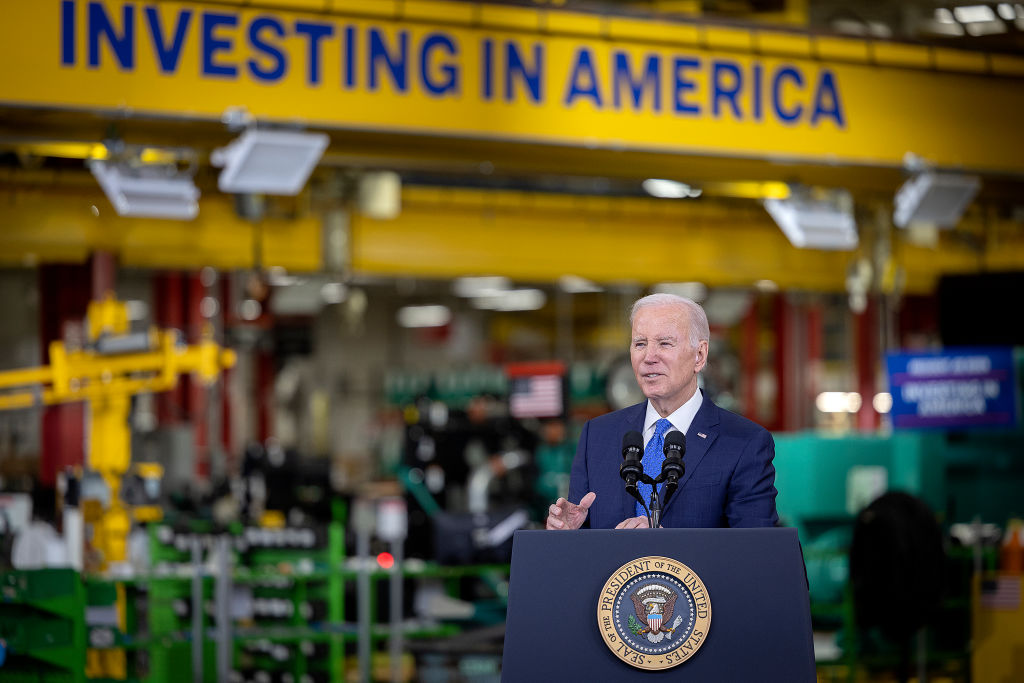
President Joe Biden visits the Cummins Power Generation Facility as part of his Investing in America tour in Fridley, Minnesota, on April 3, 2023. (Elizabeth Flores / Star Tribune via Getty Images)
There’s something happening here / But what it is ain’t exactly clear.
The Other Crisis
The go-to crises of the socialist left have been “American declinism” and “interimperial rivalry.” These crises have not only been predicted by the Left but often wished for, the Left seeing them as doing much of the heavy lifting it cannot do on its own. This is both bad analysis and worse politics. It overstates declinism, wrongly projects the (very real) tensions between the United States and China into a contest over who will lead global capitalism, and assumes that things getting worse inherently advances progressive politics.
The United States is not — apart from China — facing any definitive decline relative to its main economic competitors. Nor is it facing a profit squeeze; corporate profits have been running at their highest-ever share of GDP (see chart below), and nonfinancial profits per unit of real output were 74 percent higher in 2022 than in 2006 (i.e., before the 2008–09 financial crisis). As for the relationship with China, economic competition has indeed intensified, but the mutual dependence of the United States and China blocks the kind of rivalry that shaped left thinking a century ago. The challenge — for both countries — is how to manage the militarization of technology without undermining the broader free trade and capital flows that characterize the present global order each are so dependent on.