The United Auto Workers Strike Is Already Shaking Up the Presidential Race
The UAW strike has rocketed into the presidential race, with Trump announcing a speech to autoworkers and the union trying to use Biden’s electric vehicle subsidies to open the sector to unionization. The strike's result will have major political implications.
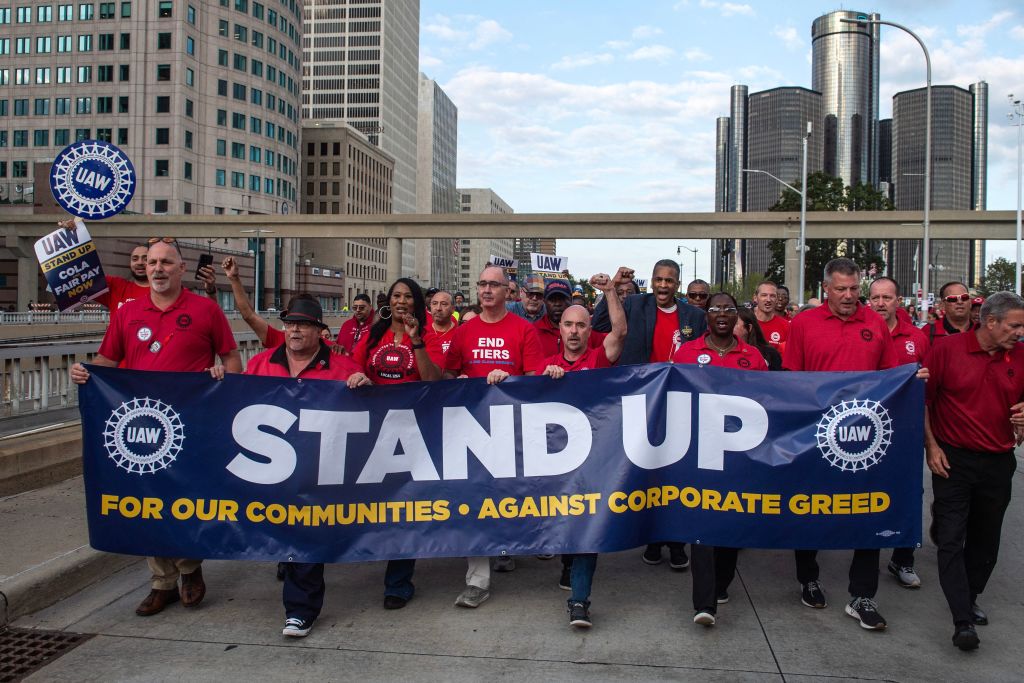
Members of the United Auto Workers march through the streets of downtown Detroit following a rally on the first day of the UAW strike in Detroit, Michigan, on September 15, 2023. (Matthew Hatcher / AFP via Getty Images)
The United Auto Workers (UAW) strike against the Detroit “Big Three” auto companies is rapidly turning into a political conflict of enormous implications, whose outcome will reverberate into the 2024 presidential election and shape the economic and social terrain upon which a transition to a green economy is grounded. It already seems likely that Donald Trump will visit a UAW picket line in Michigan, and the speculation is that if he does so, President Joe Biden’s appearance outside a factory gate cannot be far behind.
The political character of the current walkout now echoes some of the most consequential labor management conflicts of the last century: the UAW strike against General Motors in 1945 and 1946, when the standard of living of the entire postwar working class was at stake; the Memphis Sanitation strike of 1968, which opened the door to the unionization and empowerment of a public sector workforce that was often linked to civil rights organizing; and the tragic strike of the Professional Air Traffic Controllers Organization in 1981, whose destruction at the hands of President Ronald Reagan set the stage for years of labor defeat and demoralization.
Why the Strike is Becoming Political
We have come to this point for two reasons: first, the UAW is today led by a cohort of militants whose ambitions are expansive and transformative. President Shawn Fain’s rhetoric resembles that of both the legendary Walter Reuther, a social democrat who presided over a collective bargaining regime that doubled the real incomes of US autoworkers, and Bernie Sanders, whose denunciation of the billionaire class has animated a larger slice of the working class than any tribune since Eugene V. Debs. And there seems no doubt that a majority of autoworkers, not to mention millions of other US workers, heartily endorse the new militancy coursing through the veins of a union founded by Communists, Socialists, and Social Gospel Christians eighty-five years ago. (Fain skillfully deploys biblical texts in many speeches.)