The UAW Strike May Be a Watershed for the US Labor Movement
The UAW’s ongoing “stand-up strike” represents an earth-shattering departure from the union’s recent history. It’s the fruit of decades of efforts to transform the union and return it to its militant roots.
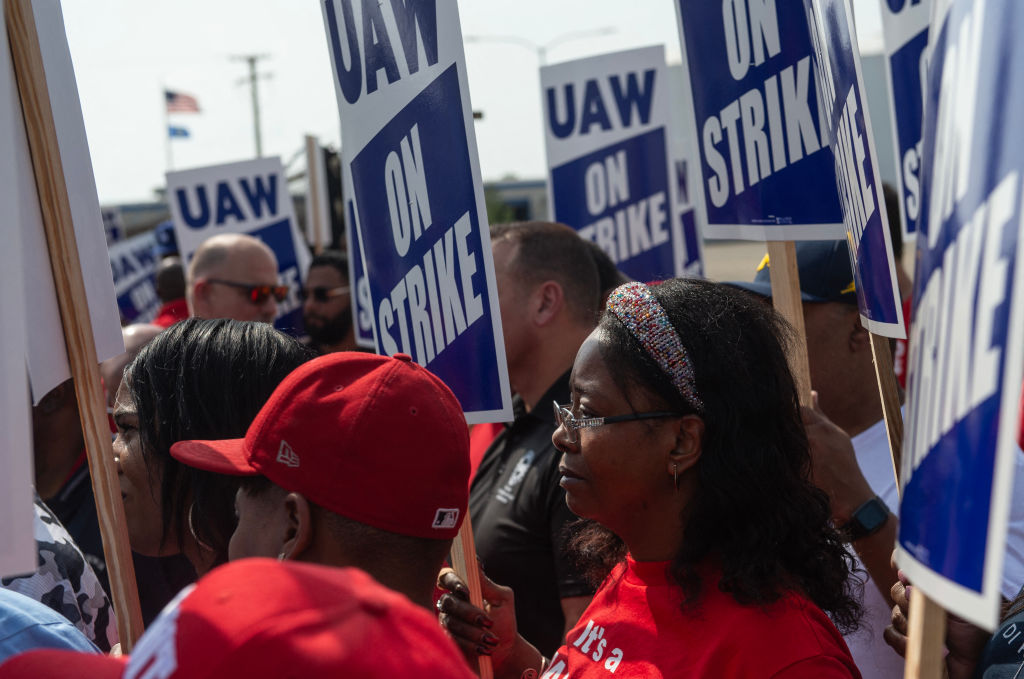
United Auto Workers members at a Stellantis parts distribution center in Center Line, Michigan, picket after walking off their jobs on September 22, 2023. (Matthew Hatcher / AFP via Getty Images)
On Friday, September 22, United Auto Workers (UAW) president Shawn Fain announced that the union would be expanding its “stand-up strike” against the Big Three automakers to thirty-eight parts distribution centers owned by General Motors (GM) or Stellantis. The five thousand workers at those sites are joining the thirteen thousand autoworkers at three assembly plants who walked out when the strike began on September 15.
The UAW’s strategy — striking all of the Big Three at once, but escalating gradually by beginning at a few worksites and calling out more over time to ramp up pressure — is unprecedented in the union’s history. The strike represents a dramatic departure from the union’s recent history in other ways as well, with leadership actively working to involve members in the contract campaign, and President Fain declaring that the union is fighting “for the good of the entire working class.” The leadership’s new approach is due in large part to the election of Fain and other officers associated with Unite All Workers for Democracy (UAWD), a union reform caucus that earlier this year swept out the corrupt old guard that had dominated UAW for over seventy years.
Jacobin contributor Teddy Ostrow recently sat down with Barry Eidlin, associate professor of sociology at McGill University, to talk about the stand-up strike’s precedents in the 1936–37 sit-downs, the long history of efforts to reform the UAW, and the current strike’s implications for the broader labor movement in the United States and Canada.