The Left Should Draw the Right Lessons From Salvador Allende’s Rise and Fall
The great achievements of Salvador Allende’s socialist government in Chile have often been overshadowed by its brutal defeat. But the fall of his government wasn’t inevitable.
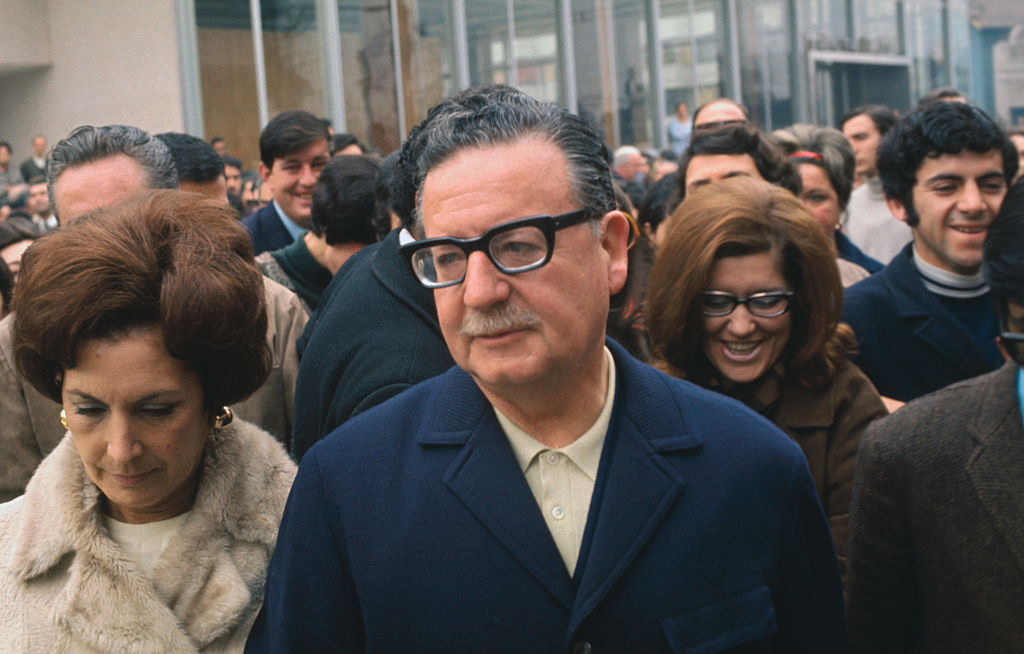
Salvador Allende arriving at a schoolhouse with his wife, Hortensia, surrounded by a crowd. September 4, 1970, in Santiago, Chile. (Bettmann / Getty Images)
Fifty years ago, Chile’s road to socialism suffered a devastating defeat. On September 11, 1973, the Chilean military, spurred by elites, condoned by middle-class sectors, and backed by Washington, toppled Salvador Allende’s Unidad Popular (Popular Unity, or UP), a vibrant though strained coalition government helmed by the Communist (CP) and Socialist (SP) parties.
The coup, which progressives have been commemorating the world over, smashed workers’ organizations, popular movements, and democratic institutions, murdering thousands and sending orders of magnitude more to torture centers, concentration camps, and internal and international exile. In ushering in a seventeen-year dictatorship and laying the groundwork for thirty years of postauthoritarian free-market supremacy in Chile, it also seemed to eliminate one the most promising experiments in democratic socialism from working-class and radical strategic arsenals.
To our great disadvantage, radicals seem convinced that the UP’s road to socialism — the extraordinarily complex endeavor to build an “institutional apparatus for a new form of pluralistic, free socialist order,” as Allende put it — was doomed from the beginning. Over the decades, our political vision remains mired in the polarized assessments first offered in the heat of Allende’s coalition’s tumultuous years in power.