The Unfulfilled Promise of the Freedom Budget
Activist and organizer Norman Hill was present for every major development in the civil rights movement during the 1960s. He spoke to Jacobin about the arc of the movement, the legacy of its leadership, and the lessons for the modern left.
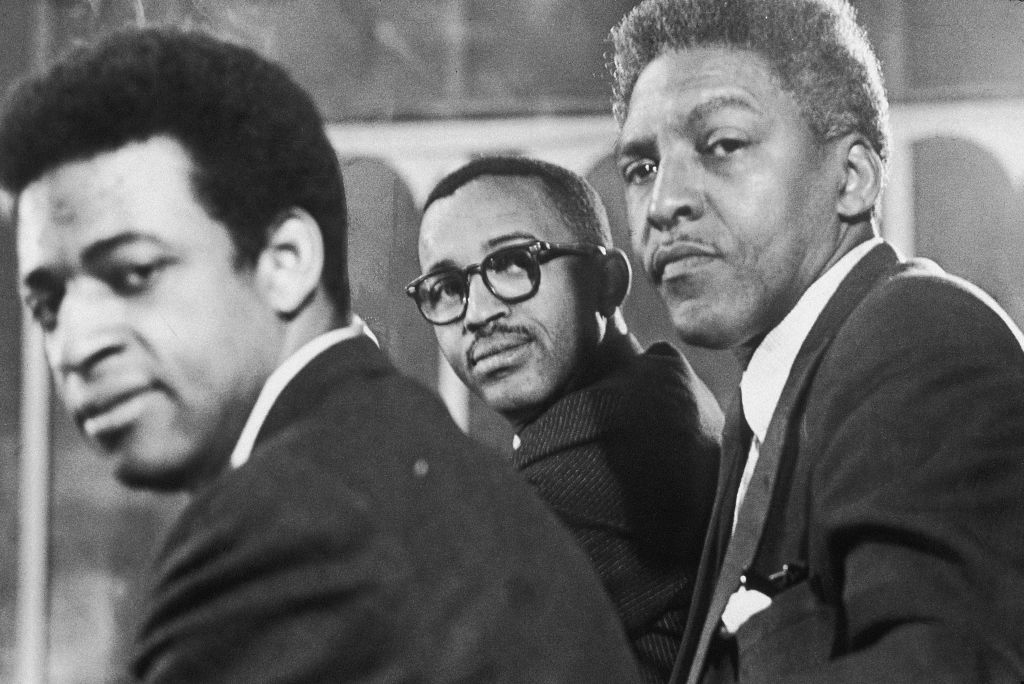
Norman Hill (L), Frederick D. Jones (C), and Bayard Rustin (R) at a press conference in Harlem, New York City, on May 4, 1964. (Arthur Brower / New York Times Co. / Getty Images)
With the sixtieth anniversary of the March on Washington coming up and a new Netflix biopic on Bayard Rustin out this November, now is an opportune time to reassess the legacy of Rustin and his mentor A. Philip Randolph, organizers of the iconic 1963 March.
A common story on the Left goes that Rustin and Randolph “sold out” after the March, having cozied up to Lyndon Johnson’s administration and drifted to the center. But the real story is far more complex, as evidenced amongst other things by the fact that it was after the march that Rustin and Randolph formulated the Freedom Budget for All Americans, a comprehensive reimagining of the federal budget that could be easily mistaken for Bernie Sanders’s presidential campaign platform. In an article for the forthcoming issue of Catalyst, “The Jobs and Freedom Strategy,” Benjamin Y. Fong reconstructs the strategy informing the Freedom Budget campaign, arguing that it offered a path forward for the civil rights movement of the mid-’60s and bears lessons that remain applicable to the present.
As part of the research for his Catalyst article, Fong interviewed Norman Hill, who was highly active in the civil rights movement from the earlier desegregation efforts to the post-March period. In the early 1960s, Hill was national program director of the Congress of Racial Equality (CORE), where he coordinated the campaign to desegregate restaurants along Route 40. In 1963, Hill served as staff coordinator for the 1963 March on Washington for Jobs and Freedom. From 1964 to 1967, during which time both the Civil Rights Act and the Voting Rights Act passed, he was the legislative representative and civil rights liaison of the Industrial Union Department of the AFL-CIO. In 1967, Hill joined the A. Philip Randolph Institute as associate director under Rustin and eventually became its executive director and president, building out over two hundred chapters of the institute around the country.