How American Universities Turned Red
A century ago, universities were hotbeds of reaction, and Ivy League undergraduates would leave class to break strikes. The Left has now built a base within the academy, but without ties to organized labor, these movements will achieve little.
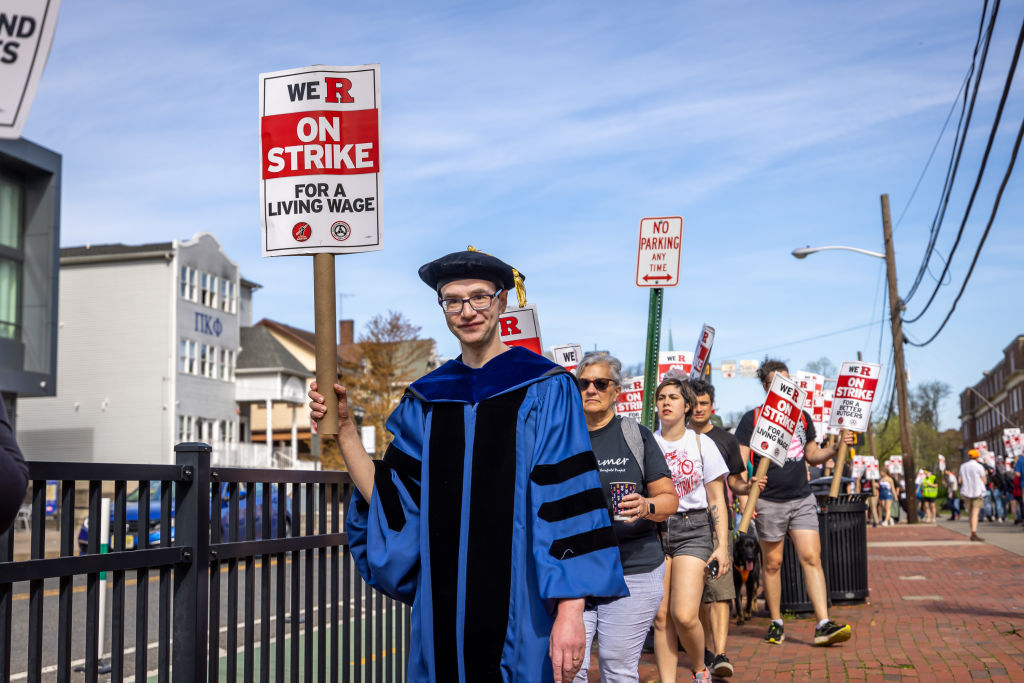
A professor at Rutgers University participates in a strike in New Brunswick, New Jersey, April 12, 2023. (Michael Nigro / Pacific Press / LightRocket via Getty Images)
In 1919, an annus mirabilis of global revolution, Helen Taft was president of Bryn Mawr College. She was also the daughter of the Republican president and Supreme Court justice William Howard Taft, and sister of Robert Taft, author of the anti-labor Taft-Hartley Act. Nonetheless, she endorsed the right of workers to strike and remarked that, “the wealthy men of the country certainly owe the professors a living wage.”
The views of Helen Taft were heterodox both within her family and in academia more widely. While the rest of the country was aflame with labor standoffs from the Seattle dockyards to the steel mills of Pittsburgh, campuses stayed silent. When they did decide to join in on the action it was to supply undergraduate strikebreakers, who descended from august institutions like Harvard to undermine organized labor.
Colleges had been sites of elite conservatism since the first colonial-era seminaries. If you taught or studied there, the chances were high that you were already part of the ruling order, or hoped to join its ranks or work in its service. Bryn Mawr was an anomaly; so, too, were radically minded professors like Thorstein Veblen or Charles Beard or John Dewey, not to mention W. E. B. Dubois.