Adolph Reed: We Must Avoid Race Reductionism
The black population in the United States is roughly the size of the population of Spain. Yet too many ignore class differences and political complexities among millions of African Americans.
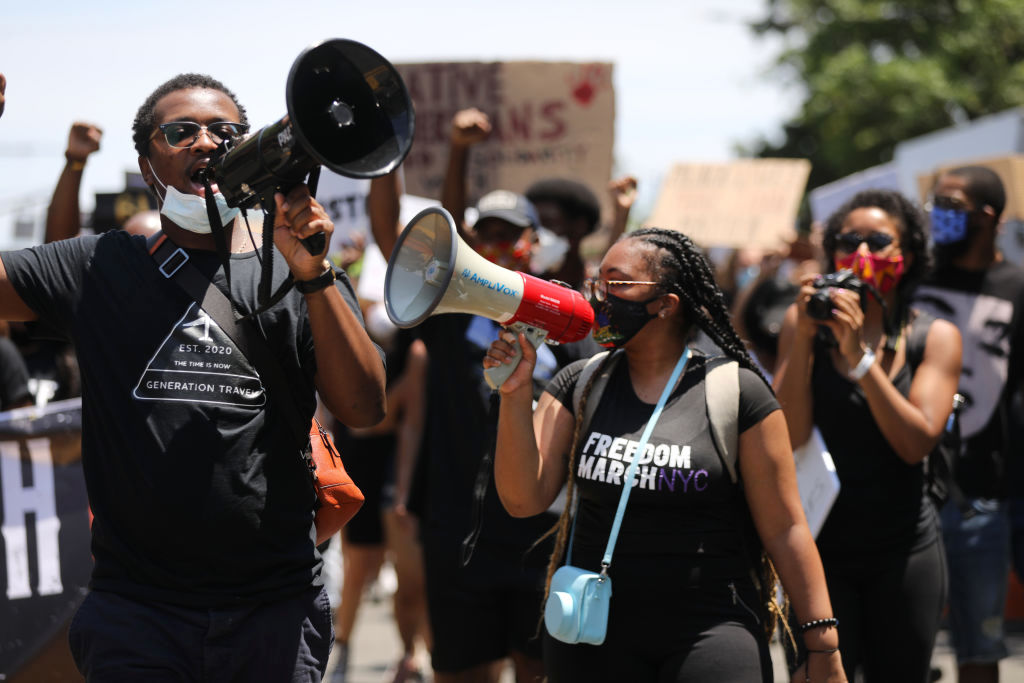
People participate in a march in Brooklyn for Black Lives Matter and to commemorate the 155th anniversary of Juneteenth on June 19, 2020 in New York City. (Spencer Platt / Getty Images)
At forty-seven million, the African American population in the United States is roughly equivalent to that of Spain. Despite the size of one of America’s largest minorities, discussions of black politics tend to be reductive and ahistorical. In cavalier fashion, critics of racism chart a long line of oppression that has its origin in the United States’ earliest days. Similarly, the forces that have, according to the dominant view of American racism, sought to oppose this monolithic racial tyranny have all fought under the single banner of “the black liberation struggle.”
Admittedly, these attempts to examine the history of discrimination offer correctives to right-wing defenses of forms of ascriptive hierarchy. However, they do so at the cost of flattening the complexities of actually existing black politics. This approach ignores, the political theorist Adolph Reed Jr tells Jacobin, that black politics is not immune from the economic and class forces which have and continue to shape American politics more broadly.
Jennifer C. Pan
You’ve been a longtime critic of the notion of a cohesive or transhistorical “black freedom movement,” or the idea that one can trace an unbroken line from the fight to abolish slavery to the civil rights movement to Black Lives Matter. Why isn’t this framework helpful for understanding black politics either now or in the past?
Adolph Reed