Police Exist to Manage and Contain the Surplus Population
The 2020 George Floyd protests made millions of Americans aware of the horrors of police violence. But to build a mass movement to end that violence, we must recognize that police control people of all races who are unable to legally make ends meet.
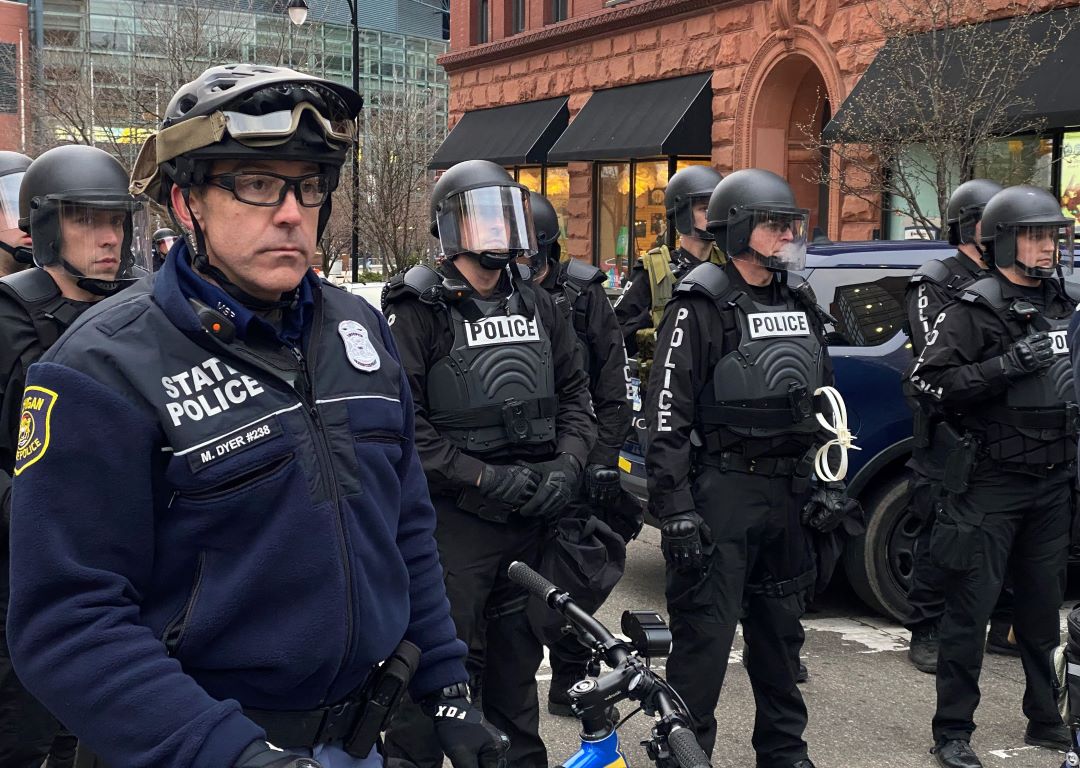
Police in riot gear gather during a demonstration after the fatal shooting by a police officer of Patrick Lyoya in Grand Rapids, Michigan, April 16, 2022. (Mustafa Hussain / AFP via Getty Images)
In 2020, the mass demonstrations that exploded across the country over the police murder of George Floyd spurred a nationwide reckoning on race and an outpouring of promises from politicians to enact policing reform. In the intervening years, however, little in the way of policing in the United States appears to have changed. Last year, for instance, over 1,100 people were killed by police.
In his new book, After Black Lives Matter: Policing and Anti-Capitalist Struggle, political scientist Cedric Johnson explores the origins and consequences of what he calls stress policing, or the style of law enforcement that emerged out of “broken windows” initiatives in the carceral expansion of the 1980s. Johnson argues that, contrary to popular conceptions, policing in the United States is not primarily an expression of antiblackness or white supremacy, but rather functions to secure the conditions for perpetual capital accumulation, in large part by managing a surplus population that is increasingly multiracial. “Police violence,” he writes, “is not meted out against the black population en masse but is trained on the most dispossessed segments of the working class across metropolitan, small town and rural geographies.”
And while “Black Lives Matter” has been a powerful rallying cry in the streets, Johnson further demonstrates that the focus on racial disparities among victims of police violence tends to detract from the creation of the kind of majoritarian political coalition that will ultimately be necessary to roll back the carceral state. In an interview with Jacobin, he discusses his new book and offers a perspective on how working people — and the labor movement in particular — can collectively contest police violence.