The Myth at the Heart of Modern Economics
A fabricated story about the causes of 1970s inflation — repeated in high school textbooks and the New York Times — plays a surprisingly important role in shaping economics today. It may well have helped spur the Fed’s ongoing campaign to engineer a recession.
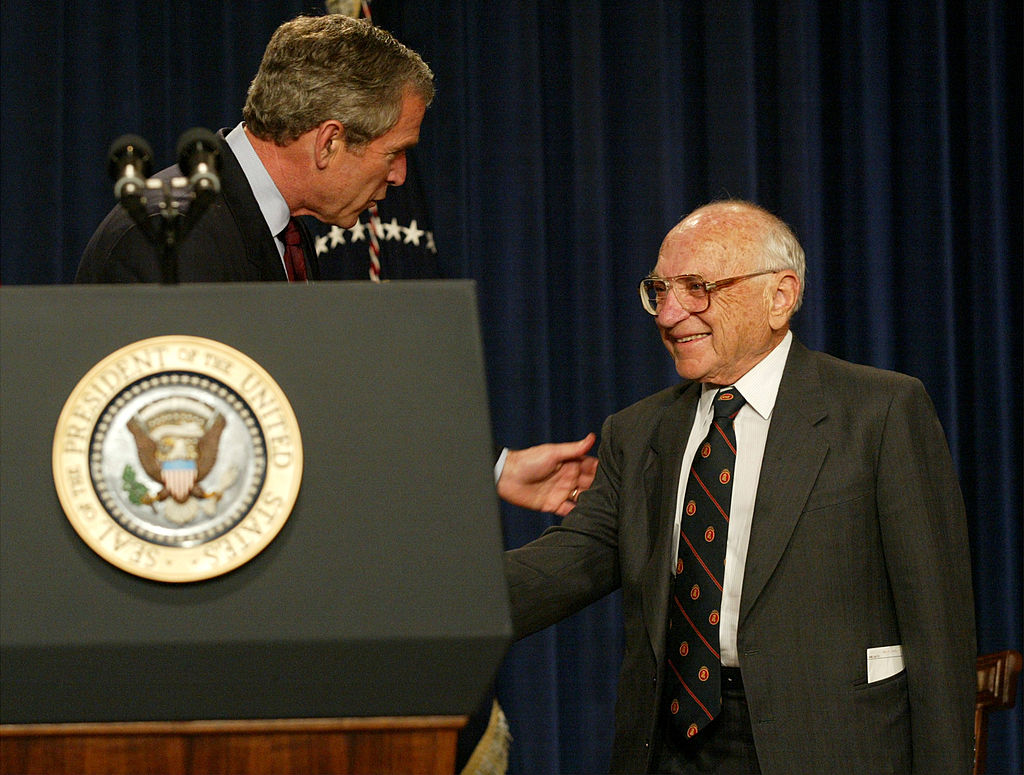
President George W. Bush greets Milton Friedman, recipient of the 1976 Nobel Prize for economic science, on May 9, 2002 during a White House event in Washington, DC. (Alex Wong / Getty Images)
Almost a decade ago, Oxford economist James Forder published a scholarly bombshell of a book. Titled Macroeconomics and the Phillips Curve Myth, the study exposes as pure fiction a story that for decades has functioned as a kind of master narrative of modern economics — as well as a morality tale for central bankers and other policy makers who might have been tempted to pursue policies in breach of contemporary economic orthodoxy.
The Phillips Curve Myth is the idea that in the 1960s — before Milton Friedman brought enlightenment to the world — there was a widespread but mistaken belief among economists, especially “Keynesian” economists, that policy makers could reduce unemployment using expansive policies that somewhat raised inflation, and that this result could be safely sustained over time. Only when Friedman advanced his “natural rate of unemployment” hypothesis in a 1967 paper did the economics profession come to realize its prior folly.
Jacobin’s Seth Ackerman spoke with Forder about the Phillips Curve Myth, Phillips Curve truths, and the myth’s many political uses within the economic profession and the wider world.