To Renew Working-Class Resistance, the Labor Movement Must Be Democratized
Charting a course toward labor’s revival requires a socialist political project suited to the current historical and social moment. To build this renewed working-class politics, the labor movement must be democratized.
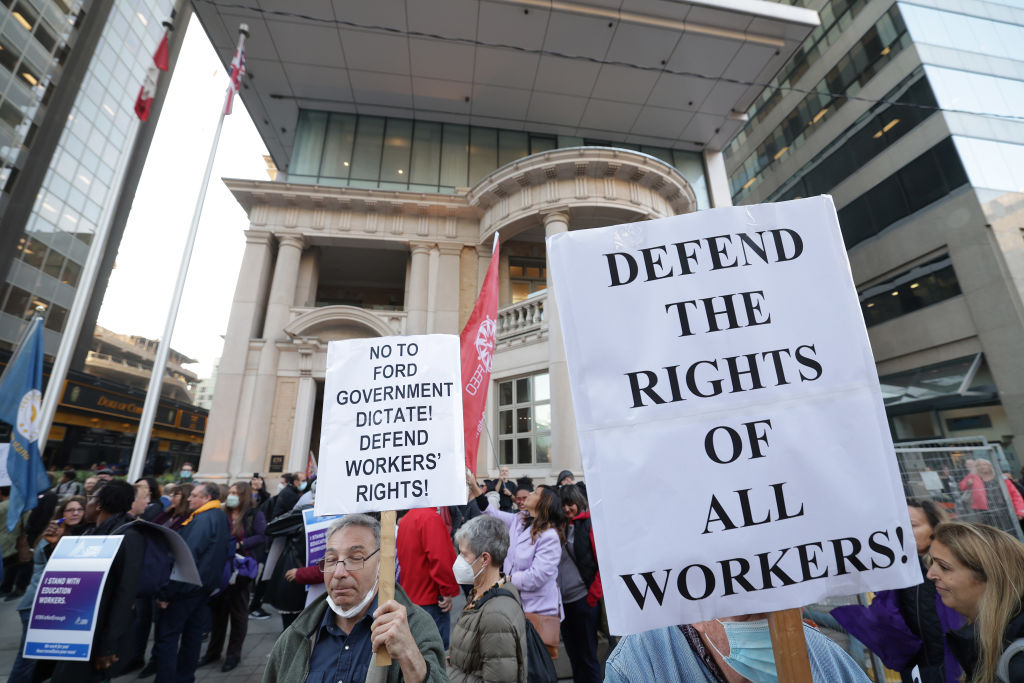
An emergency rally in response to Ontario government attacks on basic labor freedoms, Toronto, Canada, November 1, 2022. (Steve Russell / Toronto Star via Getty Images)
Much of what was achieved through the class struggles of the 1930s to 1970s has dissolved. So-called Keynesian capitalism was predicated upon a set of compromises between capital and labor that accepted organized labor as a junior partner in the management of the political economy. Social democracy, as the major political orientation within working-class politics, was instrumental here. Today, however, social democracy offers no vision of a society beyond capitalism, offering up instead a technocratic managerialism to coordinate the state and economy.
The undemocratic and increasingly authoritarian variant of neoliberal capitalism has gradually insulated state institutions from popular pressures through concentrated power in the political executive and central bank “independence,” among other transformations within the state. As there is “no going back,” these developments raise the question as to whether democratic capitalism has arrived at a dead end.
Between Past and Present: The Contours of Trade Union Struggles
How has the labor movement responded to permanent austerity and authoritarianism? One must never fall into the defeatist perspective of overestimating the dominance of capital and the state. The relations of class power in a capitalist society are asymmetric; nevertheless, the power inherent to labor, through its potential to collectively mobilize, always remains a real force. Free collective bargaining was rooted in a material basis of consent given by the expansion of postwar capitalism. As this stage drew to a close in the 1970s, the material basis of consent became more fragile. This prepared the ground for the turn to coercion and, later, authoritarianism. It also opened space for resistance to such coercion that was determined by organizational, political, and ideological factors as well as economic ones.