The Railway Labor Act Allowed Congress to Break the Rail Strike. We Should Get Rid of It.
Congress was able to break the rail strike last week because of a century-old law designed to weaken the disruptive power of unions. It’s time to cast aside this law and every other government-mandated strike prohibition that ties the hands of workers.
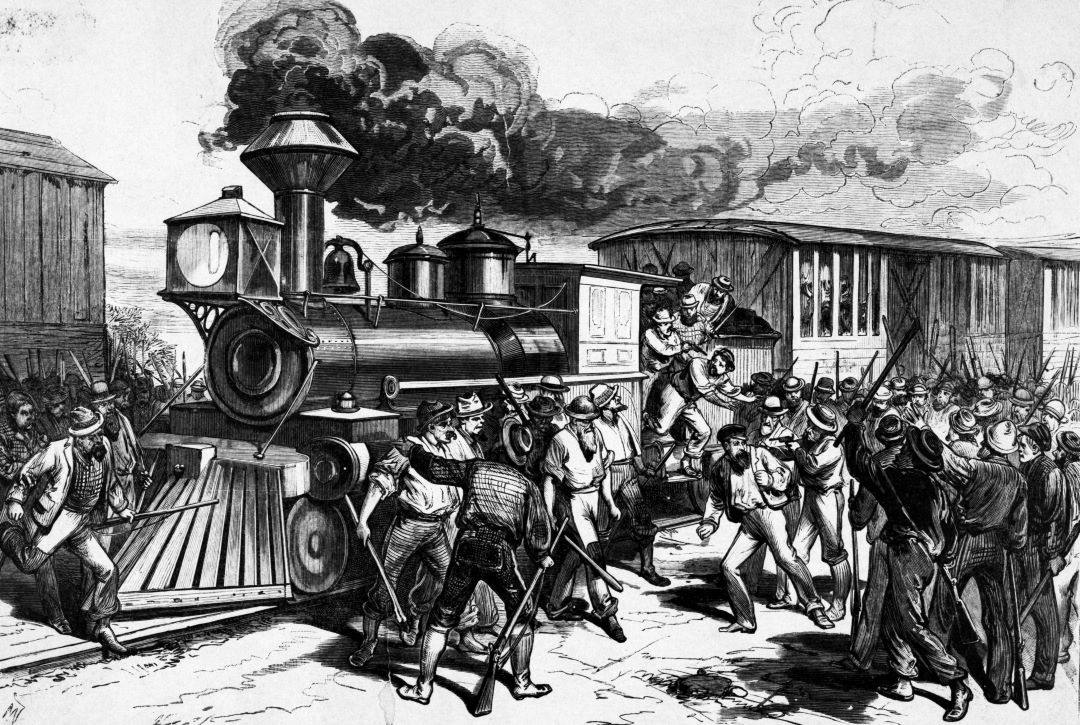
Illustration depicting workmen and firemen dragging a fireman and engineer from a Baltimore freight train during the Baltimore and Ohio Railroad strike. Woodcut, 1877. (Bettmann / Getty Images)
On Friday, December 2, President Joe Biden signed a joint resolution from Congress binding railroad workers to a September tentative agreement with the railroad corporations — a contract that a majority of railworkers had recently rejected. Joined by labor secretary Marty Walsh and transportation secretary Pete Buttigieg, Biden declared, “We’ve avoided a catastrophic rail strike.” The reason Congress could intervene in the railroad labor dispute is that a century-old law — the Railway Labor Act of 1926 — explicitly provides for the possibility of a strike while simultaneously limiting its disruptive power.
Understanding this contradiction — allowing for strikes but within narrow, government-sanctioned confines — requires a review of the history of the right to strike and its regulation in what came to be called “emergency disputes.” Whereas the US legal system looked askance at workers’ right to walkout for much of the Gilded Age and Progressive Era, the effective legalization of trade unions during the New Deal transformed the relationship between workers and bosses in the United States. If labor unions were to be legalized, US politicians reasoned, their negotiations with employers had to be regulated in those workplaces where, in the words of the 1947 Taft-Hartley Act, interruption of service “imperils the public health and safety.”
The Railway Labor Act is the oldest federal statute providing for such regulation — and proved to be one of the most decisive forces in the recent showdown between railroad workers and employers.