Unions Can Beat Anti-Labor Politicians
In November, education workers in Ontario staged a massive walkout and threatened a general strike, forcing premier Doug Ford to back down on repressive anti-labor legislation. Here’s how they did it.
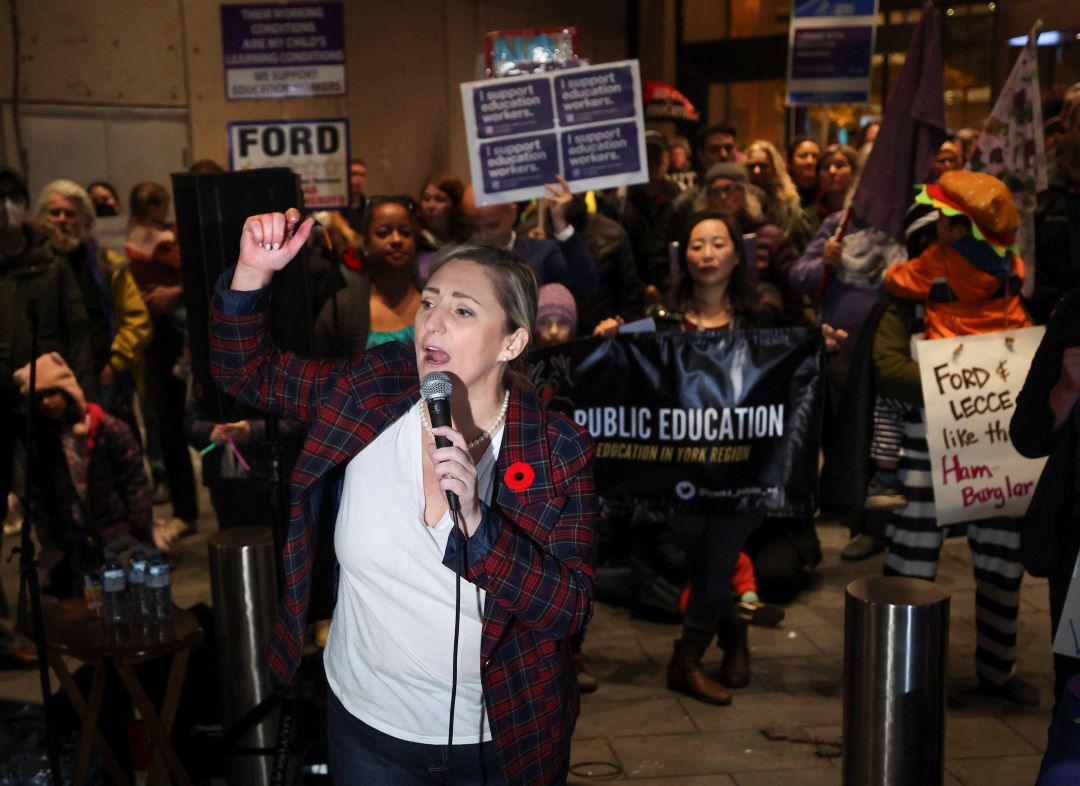
Laura Walton, president of CUPE’s Ontario School Boards Council of Unions, speaks to a crowd of several hundred parents and supporters holding a rally to show the Ontario government that they support the demands of education workers during the recent contract talks and threat of strike in Toronto on November 3, 2022. (Richard Lautens / Toronto Star via Getty Images)
In early November of this year, an all-too familiar story seemed to be unfolding in Ontario. In this case, the 55,000 education support staff workers who are members of CUPE (Canadian Union of Public Employees), Canada’s largest union, were approaching a deadline. The government negotiators had presented their final offer. Workers were about to exercise their right to withdraw their labour. It could be assumed that the Ontario Conservative government led by Doug Ford would do what other governments before it had repeatedly done: pass legislation to end the strike in the name of the “public interest.”
In this rerun of many public sector negotiations, labor leaders could be expected to go on about labor rights and democracy, but when facing the coercion of the law and fines they call on their members to return to work. And the members, feeling they had no choice, would follow the past pattern and reluctantly comply. This time, however, something different happened: the education workers refused that charade, and the conflict took a dramatically distinct and even historic turn.
The divergence from earlier experiences began with the way the Ford administration tried to end the strike. Rather than wait until the strike was actually on, Ford used his parliamentary majority to pass legislation that criminalized the right of these workers to strike even before they actually went out (in the infamous Bill 28, Keeping Students in Class Act). With inflation running just under 7 percent, the legislation imposed a collective agreement offering 2.5 percent for workers earning under $43,000 annually and 1.5 percent for those earning above that princely sum. (The distinction the government made between low-paid and less low-paid workers was perhaps intended to push 1.5 percent as the standard for future collective bargaining in the public sector with the additional sum for lower-paid workers an “exceptional” add-on for this sector alone.)