Socialism Won’t Get Rid of Work. But It Will Allow Us to Work Less Under Better Conditions.
Some leftists imagine a postcapitalist society will free everyone from the need to work. But the only realistic and fair way to manage production under socialism is to democratically distribute and share in the burdens of labor.
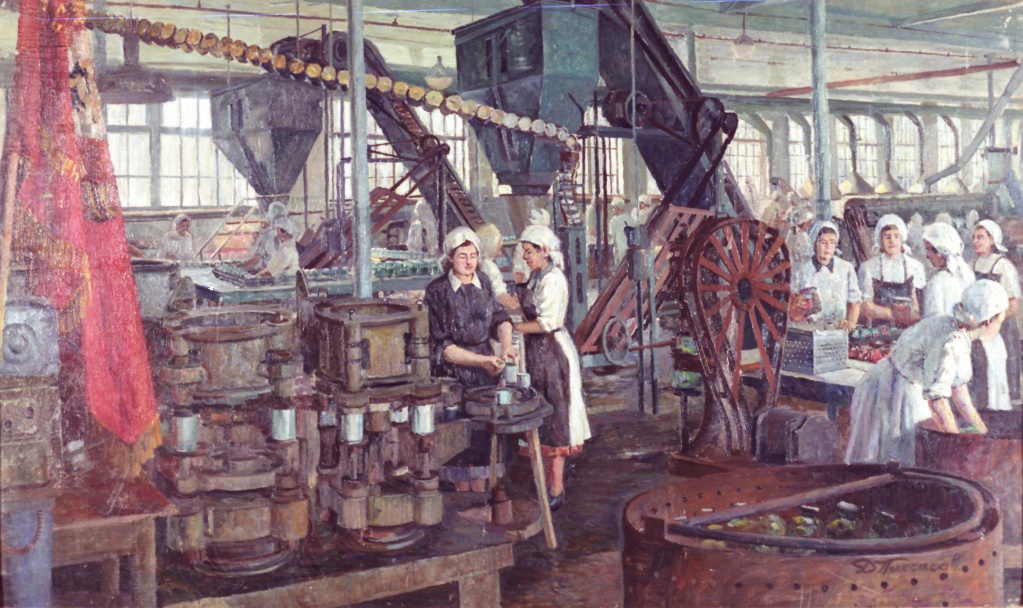
D. I. Pischasov, Canning Factory in Saransk, 1955. (Mordovian History Museum via Wikimedia Commons)
For most of us today, work sucks. Labor is organized around what’s profitable for capital rather than what’s good for our society, and workers have to take whatever jobs they can find just to afford basic necessities. Once we show up for work, we find ourselves under the tyrannical authority of the boss, and most of our effort just goes to swell his bank account.
Socialists have long promised to overturn this exploitative state of affairs. But what does that mean, exactly? “Postwork socialists” have a simple answer: abolish work. In their vision of a postcapitalist society, everyone will be freed from the requirement to work through the provision of a universal or unconditional basic income, while much or even all work will be automated.
In his Catalyst article “Post-Work Socialism?”, political scientist Alex Gourevitch argues that the postwork vision is untenable. He advocates instead for an ideal of “shared labor socialism,” in which everyone will freely share in the burdens of work once it has been separated from capitalist control and exploitation. The Jacobin Show’s Jen Pan recently interviewed Gourevitch about his criticisms of postwork socialism and why we should embrace shared labor socialism instead. The transcript has been edited for clarity and length.