You’ve Been Lied to About the 1963 March on Washington
The March on Washington was 59 years ago today. It’s popularly remembered as a moderate demonstration where MLK “had a dream” — but in fact, it was the decades-long culmination of a mass, working-class movement against racial and economic injustice.
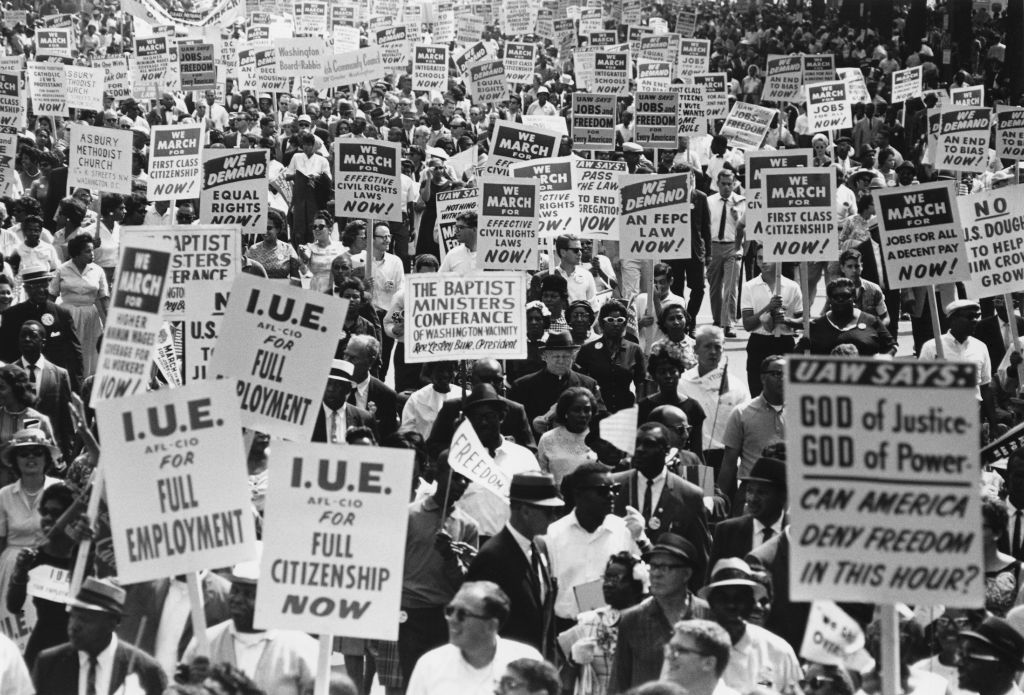
Demonstrators holding placards at the March on Washington for Jobs and Freedom, Washington DC, August 28, 1963. (FPG / Archive Photos / Getty Images)
Despite his towering contributions to the Civil Rights Movement, A. Philip Randolph (1889–1979) has somehow faded from popular memory. A black trade unionist and socialist, Randolph’s long political career started in the 1910s (when his Harlem-based magazine the Messenger staked out a pro-labor, pro-socialist position), ran through the 1930s and ’40s (when he gained renown for leading the Brotherhood of Sleeping Car Porters and the first March on Washington), and stretched well into the ’60s (when he founded the Negro American Labor Council and served as the official head of the 1963 March on Washington).
Randolph’s life alone rebuts the whitewashed versions of the Civil Rights Movement and the 1963 march. Here was a man who saw the struggle against racial oppression and economic exploitation as intimately linked; who located the locus of change in the organized masses rather than the upper crust; who regarded unions as a grand instrument to bludgeon racial injustice.
As historian William P. Jones lays out in the following interview, it was fitting that Randolph headed the August 28, 1963, March on Washington for Jobs and Freedom. For that march was a union march, a mass working-class march, a march that sought not only to end Jim Crow tyranny and racial segregation but to win a massive federal jobs program, well-funded education and housing, and a living wage for all workers.