Voters Will Opt to Tax the Rich — If They Know How the Money Will Be Spent
Last year, both Arizona and California voted on ballot initiatives to tax the rich. So why did it fail in blue state California but pass in libertarian Arizona?
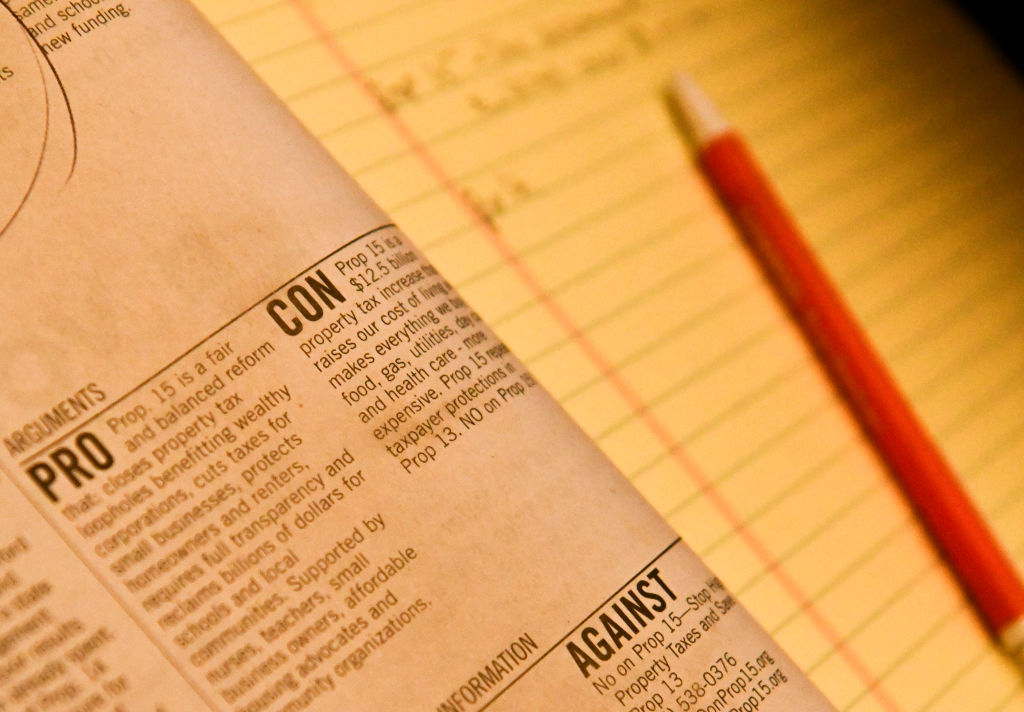
A detail of Proposition 15 arguments are shown at a ballot Zoom party to go over measures up for a vote, on October 15, 2020 in Los Angeles, California. (Rodin Eckenroth / Getty Images)
At a moment of stubborn party identification in a nauseating culture war, ballot initiatives are an attractive means of pursuing progressive reforms. Many state minimum wages around the country have been raised through ballot initiatives, despite heavy (and well-funded) opposition by local Chambers of Commerce.
Oftentimes, as in the case of Florida in the 2020 election in which Floridians simultaneously voted both for Donald Trump and a $15 minimum wage, these initiatives pass at a much higher margin than Democratic candidates win. It seems that some people who balk at anyone with a D next to their name on a ballot are willing to support measures often more progressive than many of those Democratic politicians themselves would ever introduce.
In 2020 two remarkably similar propositions were on the ballot in Arizona and California: Proposition 208 and Proposition 15, respectively. Both aimed to increase taxes, in a highly progressive fashion, in order to fund public services — public schools in particular in the case of 208. Contradicting the common stereotypes about the two states — California the liberal bastion, Arizona the libertarian heartland — Prop 208 passed, while Prop 15 failed.