The Global South Needs Power and Resources, Not Empty Representation
Nigeria's Ngozi Okonjo-Iweala is rumored to be the next president of the World Trade Organization. But placing an African woman at the top of the powerful institution will do little if it continues to push neoliberal policies that harm workers and farmers across the Global South.
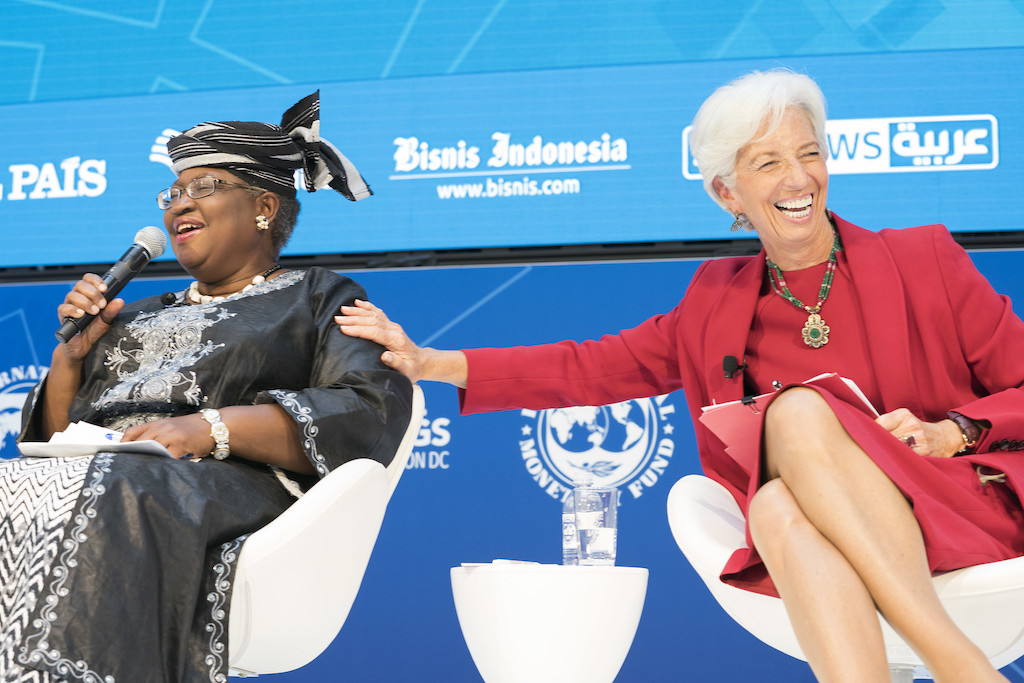
Ngozi Okonjo-Iweala (L) sits with Christine Lagarde (R), then IMF managing director and currently the president of the European Central Bank, on a panel during the IMF/World Bank Annual Meetings in 2017. (Stephen Jaffe / IMF)
Ngozi Okonjo-Iweala, the former finance and foreign minister of Nigeria, is widely expected to become the next head of the World Trade Organization (WTO). Okonjo-Iweala was in the running for president of the World Bank in 2012 before the former US president Barack Obama chose an American man, Jim Yong Kim, for the position. During her campaign for president of the World Bank — and now for the WTO — many commentators have heralded the importance of having a black African woman at the head of a major international financial institution, with one characterizing it as “a defining moment for Africa, long under the boot of foreign powers and financial institutions.” The Pan-African left must, however, reject the politics of representation for representation’s sake. If the point is to have a black African woman provide cover for the same neoliberal policies that have hindered economic development in Africa, then such representation is counterproductive.
Along with the International Monetary Fund (IMF) and World Bank, the WTO forms part of the “Unholy Trinity” of international institutions that govern global trade and the financial system to the benefit of major multinational corporations and their shareholders, and to the detriment of ecosystems and workers everywhere. The WTO was created in 1995 at the height of post–Cold War neoliberal triumphalism. It replaced the looser General Agreement on Tariffs and Trade (GATT) with a permanent organization that could more easily sanction countries that tried to restrict foreign trade, most notoriously by giving foreign investors the ability to sue states under an opaque arbitration process. The GATT had allowed Global South governments to implement modest forms of infant industry protection and other trade restrictions for development purposes. The US and European governments sought to weaken these provisions and extend principles of free trade to services and intellectual property. A global coalition of labor and environmental groups famously stunned the organization with protests that disrupted its annual meeting in Seattle in 1999.
Despite being hailed as a “development round” — ostensibly focused on the needs of the poorest nations — the latest series of global trade negotiations stalled as governments in the Global South, led by India and China, resisted further opening their markets to North American, Western European, and Japanese capital. They also insisted that governments in the Global North open their markets to agricultural exports from the South by reducing trade barriers, especially their massive subsidies to domestic agribusiness.