Karen Lewis Met Her Moment
When Karen Lewis and her Caucus of Rank-and-File Educators took power in the Chicago Teachers Union in 2010, the landscape for labor in her city and country was bleak. She rose to the moment — and helped transform what was politically possible for a teachers’ union and the labor movement as a whole to accomplish.
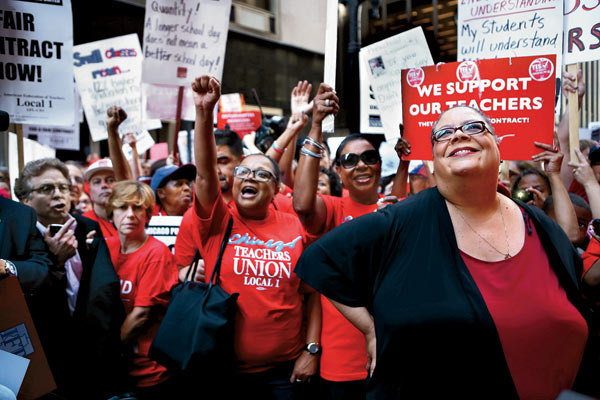
(Courtesy of Chicago magazine)
I first met Karen Lewis in the back of a conference room at a suburban Detroit hotel, during the biannual Labor Notes conference in April of 2010. The Caucus of Rank-and-File Educators (CORE) was waging a valiant fight to take control of the Chicago Teachers Union, a fight that I assumed would end with an election loss but maybe one of those “moral victories” gained, the kind to which leftists often cling to console themselves after yet another defeat.
The spring of 2010 was not a high-water mark for a fighting labor movement, or for a project of left-wing political revival in Chicago. A rank-and-file uprising in a major Teamsters local in the city, Local 743, where longtime union reformers had successfully won leadership and begun the long and hard process of turning their union around, was in the midst of an attack from the old guard over a minor procedural issue — an attack that ultimately ended up being successful, kicking leaders Richard Berg and Gina Alvarez out of the union. Sparks of hope in recent years — the 2008 factory occupation at Republic Windows and Doors, the hundreds of thousands who flooded the streets to fight for immigrant workers’ rights on May Day 2006 and on each subsequent May 1, successful union organizing victories for tens of thousands of home health care and childcare workers in the middle of the decade, a united front effort of labor and community organizing forces in 2007 that successfully defeated nine incumbent city council members in the wake of our losing a major fight against Walmart — were waiting for a catalytic force to bring them together into something greater than the sum of their parts, and something that could actually win.
CORE formed in 2008, a scrappy group of teacher activists dedicated to the transformation of their union. CORE was not then, and is not now, a caucus dedicated purely to the idea of union reform. It was and is an organization that saw reform and democratic control of its union as necessary building blocks for a much larger fight — one against entrenched capital and a power structure built to extract maximum profit from the city’s largely black and brown working-class communities. Its vying for the leadership of one of the city’s most important unions seemed like an uphill battle against long odds.