The Supreme Court Will Not Deliver Justice on Abortion Rights
The Supreme Court’s abortion rights decision yesterday provides a brief respite to women across the South. But we’re still playing defense in the courts. Our offensive should be in the streets.
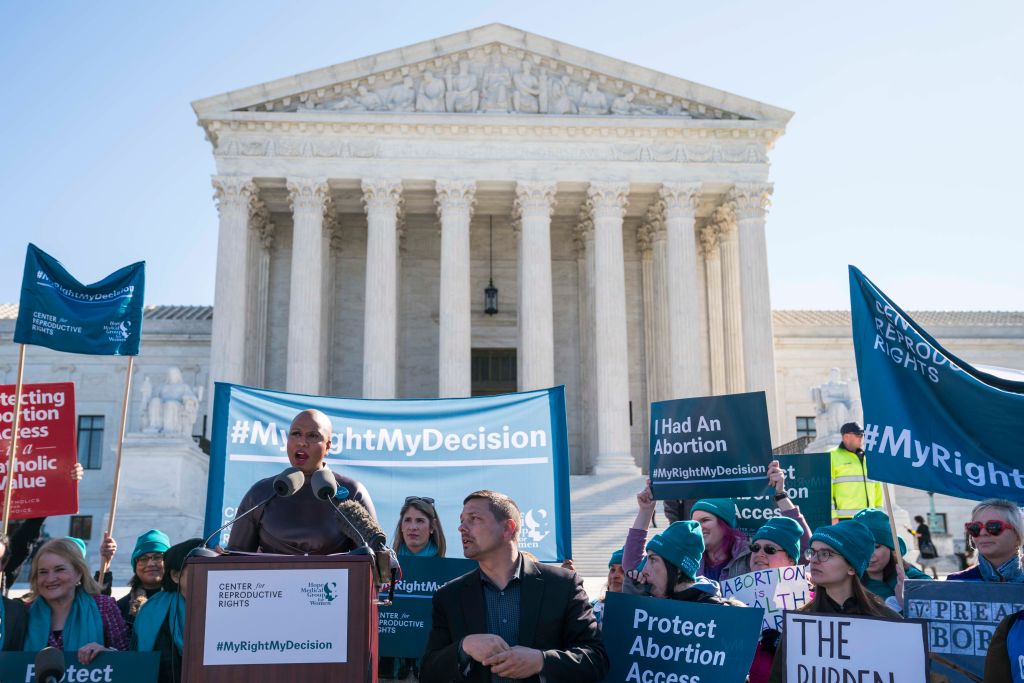
Abortion rights rally outside of the Supreme Court in Washington D. C. as the justices hear oral arguments in the June Medical Services v. Russo case. (Sarah Silbiger / Getty Images)
Defying expectations, the Supreme Court narrowly struck down a hyper-restrictive Louisiana abortion law on Monday. The court ruled 5 to 4 in June Medical Services v. Russo that Louisiana can’t require abortion doctors to have admitting privileges at nearby hospitals, cutting off one avenue anti-abortion lawmakers had hoped to use to trample abortion access, while signaling it would view other restrictions more favorably in coming sessions.
Yesterday’s ruling provides some relief for women across the South. A lower court had blocked the law, finding that if the rule had gone into effect, Louisiana would have been left with one clinic and one doctor to meet a demand of around ten thousand abortions a year. (The decision was reversed on appeal.)
Since the Louisiana law is identical to a Texas statute the court halted four years ago, court-watchers wondered what Chief Justice John Roberts would do. In 2016, he approved the restrictions that Texas had imposed in Whole Woman’s Health vs. Hellerstedt. But on Monday, Roberts sided with the three women on the court — Elena Kagan, Ruth Bader Ginsburg, and Sonia Sotomayor — and with Stephen Breyer, who wrote the decision.