When Union Militancy Isn’t Enough
The GM strike was a reminder of two old lessons: rank-and-file militancy is the foundation of working-class struggle. But to win, we need a broader socialist politics that can both support worker organizing and push it further.
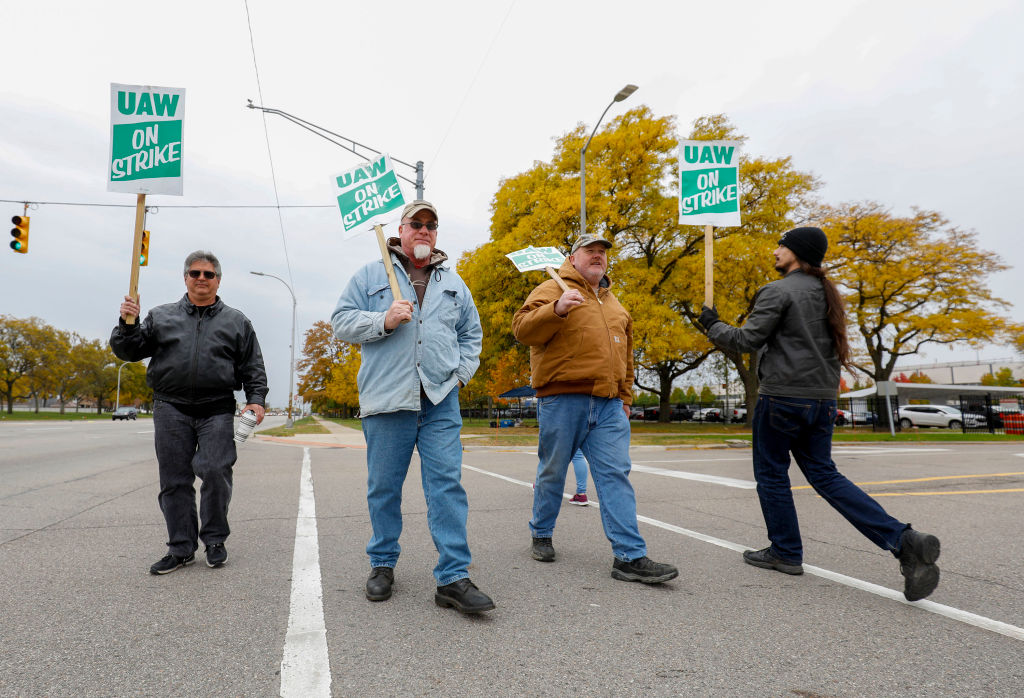
United Auto Workers union members picket at the General Motors Tech Center for the sixth week of their national strike against General Motors on October 25, 2019 in Warren, Michigan. Bill Pugliano / Getty Images
On September 16, 2019, forty-six thousand defiant General Motors (GM) workers streamed out on strike. This eruption of long-festering worker anger and frustrations was directed not only at a corporation that had treated its workforce so shabbily, but also at the often-complicit role of their own union. The strike call came from the UAW’s top officers, but it was clearly the rank-and-file who were in the lead. Nothing GM was ready to offer before the strike could have met the workers’ goals, and a strike was virtually inevitable. The strike lasted six weeks, the longest at GM’s US operations in half a century.
In taking on GM, autoworkers were driven by their own particular grievances. But they couldn’t help but be emboldened by the wider upsurge of worker militancy in the United States. In 2018, almost half a million American workers had participated in major strikes (i.e., strikes with one-thousand-plus workers) — the most such strikes since 1986 and a trend that continued into 2019. Moreover, as with the surprising empathy eight years earlier for Occupy’s challenge to the “1 percent,” the strikes touched an oppositional nerve among a significant portion of the public — a sense, not necessarily well defined, that the union battles expressed the animus of “the many” to the grotesque inequality that had come to characterize American society.
A recent Gallup Poll further documented the pro-union temper of the times, noting that “union approval is near a 50-year high.” This mood was graphically captured in the presidential primaries as Democratic hopefuls clamored to present themselves as having the closest union ties and promising the most progressive labor legislation. Some of the candidates even moved beyond the usual anodyne laments for the disappearing “middle class” and, following Bernie Sanders, dared to reference the “working class” and emphasize the priority of empowering unions.