The Long Arab Spring
The recent uprisings in Sudan and Algeria show that the conditions that gave rise to the Arab Spring are not going away. But movements against authoritarianism and exploitation still face existential threats.
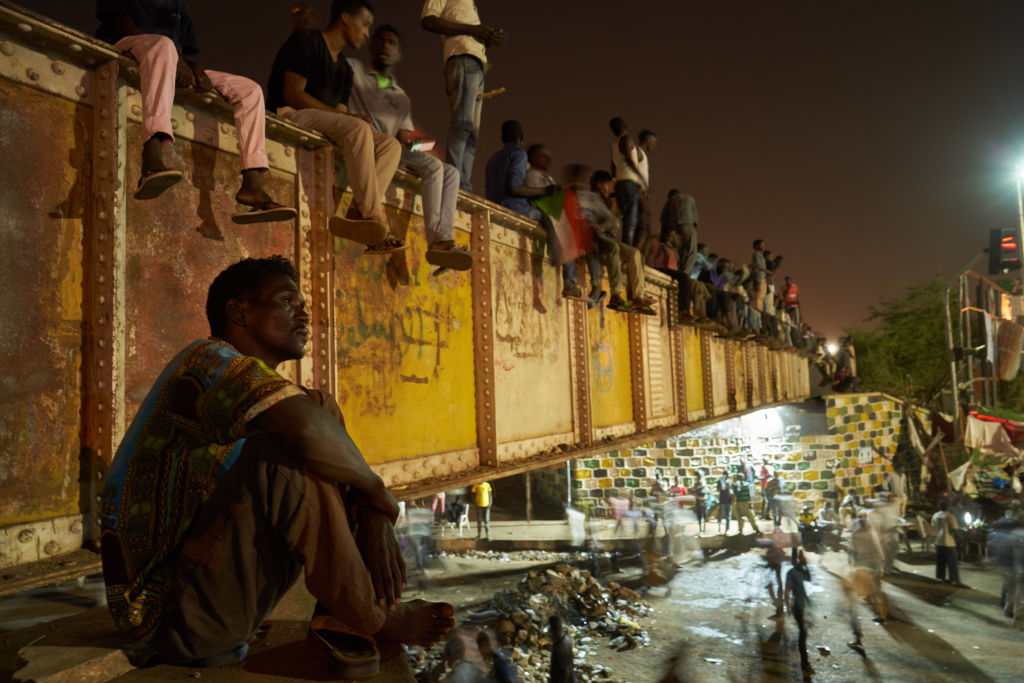
Protesters gather and wait in the sit-in on May 4, 2019 in Khartoum, Sudan. David Degner / Getty
After years of counterrevolution and bloodshed, the Middle East began to see some glimmers of hope last month. In Algeria and Sudan, mass demonstrations emerged to challenge the autocratic regimes of presidents Abdelaziz Bouteflika and Omar al-Bashir, respectively. And in that respect, both have been successful: both leaders have been removed, their decades-long rules at an end. But protests have continued, because as in Egypt after the 2011 revolution, the basic power structure behind those leaders remains intact. So do the material conditions driving the uprisings: the rock-bottom wages, mass unemployment, insecurity, and lack of a future for youth baked into the structural adjustment model imposed by the IMF.
Thus, popular forces in Algeria and Sudan are in a precarious position. The specter of the counterrevolution waged against the actors of the Arab Spring looms large. But today’s protesters have learned from the recent struggles in the region, and may benefit from such retrospective vision. To discuss the dangers and hopes of these developments, Jacobin contributor Ashley Smith spoke to Gilbert Achcar, who has written extensively about the Arab Spring and the politics of the Middle East.
Ashley Smith
The uprisings in Sudan and Algeria have inspired renewed hope in the Middle East and North Africa after a long period of counterrevolution. What is happening in these two countries?
Gilbert Achcar