The Fall of Sudan’s “Morsisi”
The Sudanese people just toppled their longtime autocratic leader, Omar al-Bashir. It's a confirmation that the revolutionary ferment of the Arab Spring didn't die out in 2011.
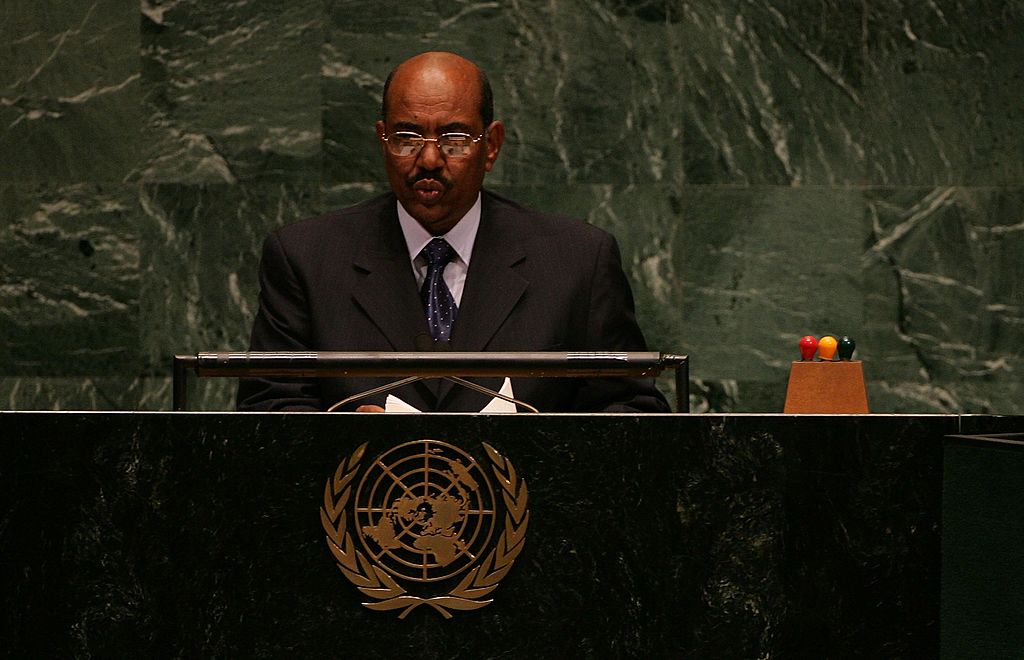
Former Sudanese president Omar Hassan al-Bashir addresses the 61st United Nations General Assembly September 19, 2006 at the UN in New York City.Spencer Platt / Getty
On December 17, 2010, the self-immolation of a young street vendor in Central Tunisia set off a revolutionary fire that spread across the region. Eight years later, on December 19, 2018, the Sudanese government’s implementation of austerity measures prescribed by the International Monetary Fund sparked a new upsurge of mass protest. And two months after the Sudanese uprising exploded, the Algerian population started its own revolt, squaring off against an arrogant military regime poised to renew the presidential mandate of the sickly, barely functional Abdelaziz Bouteflika.
The two uprisings, while still eclipsed by the conflagrations of 2011, have made the regional situation look more and more like an Arab Spring redux. More fundamentally, the new outburst of revolutionary ferment — following the ebb that began in 2013 and still persists in countries like Syria, Egypt, Libya, and Yemen — is a strong confirmation that the 2011 explosion was not merely a “spring,” in the sense of a brief and smooth phase of political democratization. It was rather the initial phase of a long-term revolutionary process, driven by a structural crisis related to the social and political nature of the region’s regimes. Indeed, even though the winds of reaction and restoration have been buffeting the region since 2013, the social turmoil never entirely dissipated: local eruptions of social anger have occurred in various countries of the Arabic-speaking world, such as Iraq, Jordan, Tunisia, and Morocco. Iran, though not an Arabic-speaking country and a very peculiar kind of state, also joined the fray.
The Sudanese military junta’s announcement yesterday that it has toppled its former leader, Omar al-Bashir, and is assuming power for two years before handing it over to an elected government, is suddenly giving the redux an air of déjà vu. It resembles the Egyptian military junta’s announcement on February 11, 2011 that it was dismissing Hosni Mubarak and seizing executive power for a transitional period. There are two major differences, however, between Sudan and Egypt — and they’ll help shape the outcome of the Sudanese upheaval.