What Black Life Actually Looks Like
For too long, the Left has organized based on caricatures of black political life. If it wants to win, it needs to start recognizing the role of class in black America.
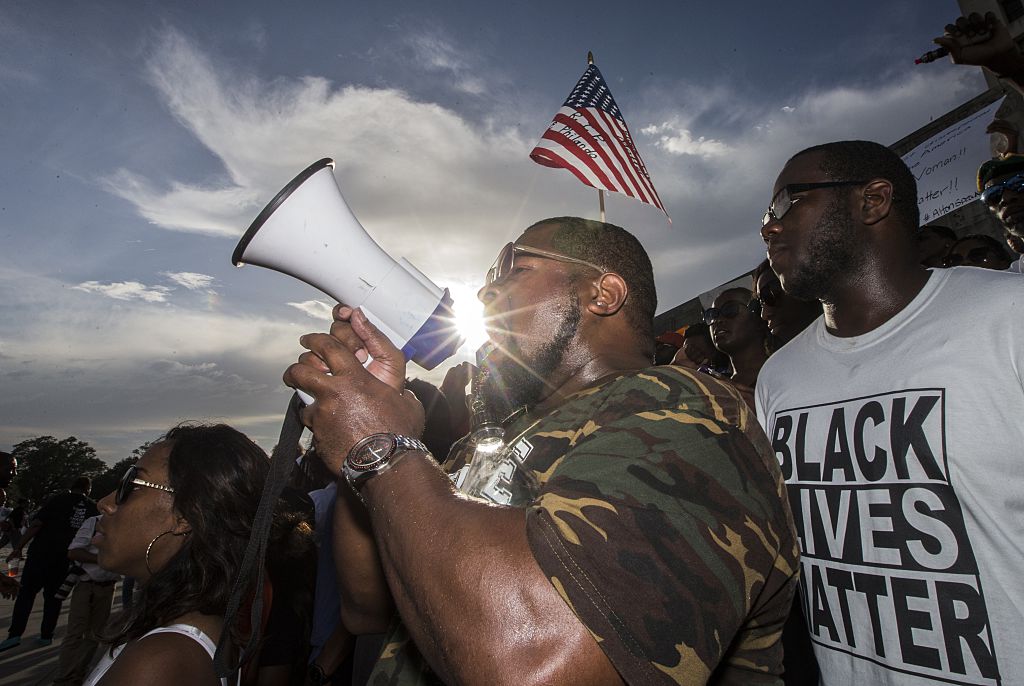
Lael Montgomery (C) and other demonstrators gather after marching at the Louisiana Capitol to protest the shooting of Alton Sterling on July 9, 2016 in Baton Rouge, Louisiana.Mark Wallheiser / Getty
Over the last five years, Black Lives Matter has served as a broad banner uniting citizens from all walks of life against the most egregious and visible use of police force against black civilians. Until the election of Donald Trump, who made his “Blue Lives Matter” commitments well-known from the very moment he announced his candidacy, popular demonstrations against police killings spread like prairie fires across the country from Oakland to Ferguson, Missouri, and on to Baltimore, Chicago, Dallas, and Baton Rouge. As a rallying cry, Black Lives Matter opened up public space for disparate campaigns, networks of grieving families, criminal justice reform organizations, and localized struggles against the carceral state that had been in motion for decades.
At the same time, however, like most great slogans, #BlackLivesMatter advanced a rather straightforward, if not simplistic analysis of the issue at hand, that the problems of policing were primarily racial. Black Lives Matter fervor also unleashed a torrent of historical misinformation, conspiracy theory, and wrong-headed thinking about politics. In elevating a race-centric interpretation of American life and history, Black Lives Matter has actually had the effect of making it more difficult to think critically and honestly about black life as it exists, in all of its complexity and contradictions. Rather than clearing a path through the thickets, some left intellectuals have made peace with this overgrowth of bad historical thinking, even though it threatens to choke out the possibility for cultivating the kind of critical left analyses of society we so desperately need.
Mia White’s “In Defense of Black Sentiment,” offers criticism of my 2017 Catalyst essay, “The Panthers Can’t Save Us Now: Anti-Policing Struggles and the Limits of Black Power,” and Kim Moody’s “Cedric Johnson and the Other Sixties’ Nostalgia” addresses that essay, and my more recent New Politics essay, “Who’s Afraid of Left Populism?” I appreciate that both White and Moody have taken time to craft responses to my work. I first came to know White as part of a growing, dedicated community of scholars researching the 2005 Hurricane Katrina disaster and the long process of reconstruction and recovery that followed. White’s work stood out because of its focus on the Mississippi Gulf Coast, often neglected by the urban-studies bias towards the plight of New Orleans. I’ve never met Moody, but during the aughts, when my economist colleague Chris Gunn and I routinely co-taught a labor course at Hobart and William Smith Colleges, Moody’s writings on American working-class history were instrumental in shaping our approach to the course, and were a mainstay of our assigned readings. His 1997 book Workers in a Lean World was especially helpful for making sense of the painful impact of globalized production on the once-bustling manufacturing towns surrounding us in Western New York.