“Escalation Could Lead to a Catastrophic Outcome”
For Venezuela, the worst-case scenario of a US military intervention remains a potent threat. A long-time advisor to Hugo Chavez offers his thoughts on the country's crisis.
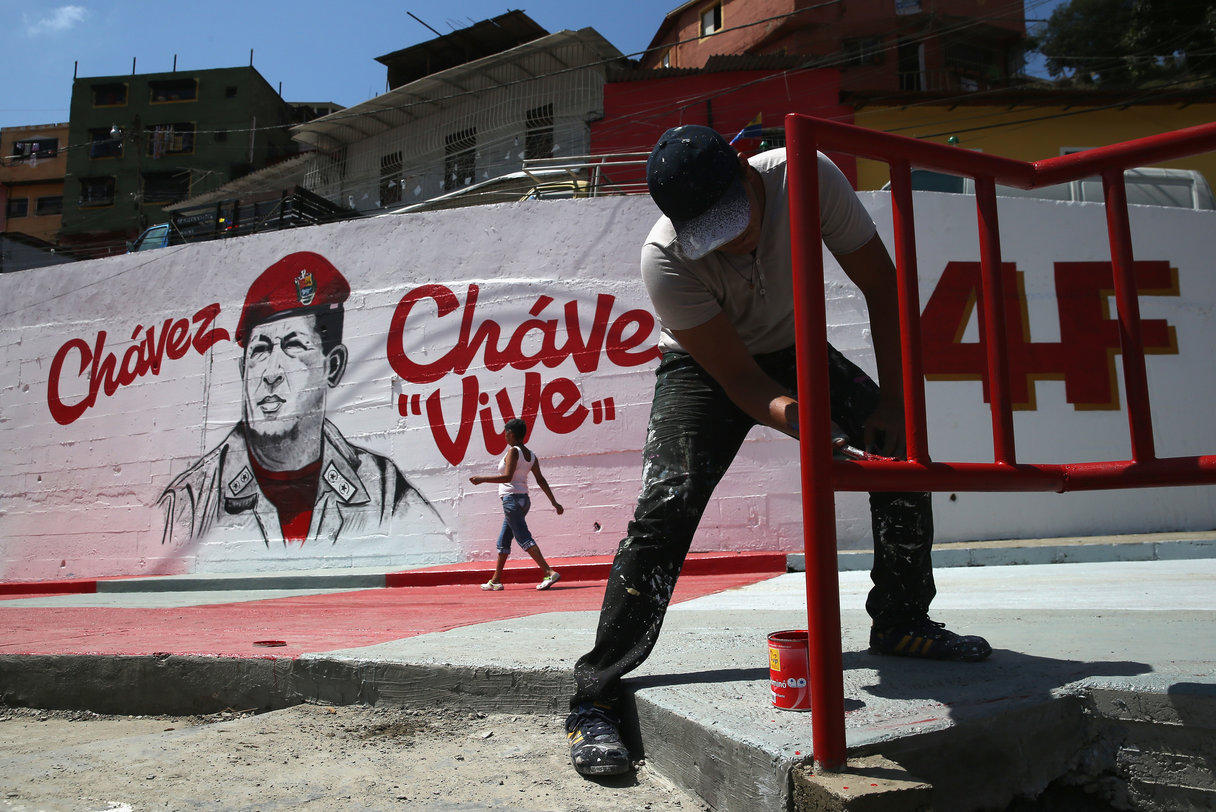
A worker paints near a mural honoring Hugo Chavez at the military barracks where the former Venezuelan president is entombed on March 4, 2014 in Caracas, Venezuela. John Moore / Getty
Given how polarized both the mainstream and left media have become with respect to Venezuelan politics, it is virtually impossible for international observers to access fair but critical assessments of Venezuela from the Left. Temir Porras has been a Chavista militant from the beginning of Hugo Chávez’s presidency in 1999 and served in a variety of important roles both in Chávez’s government, and then briefly in the government of Nicolás Maduro. Most notably, from 2004 onward he served stints as chief of staff and deputy to several foreign ministers, including Nicolás Maduro between 2007 and Maduro’s election as president in 2013. Starting in late 2013 he served briefly as the head of FONDEN and BANDES, Venezuela’s national development fund and development bank, respectively.
Porras is a long-time Chavista insider with extensive experience at the highest levels of Venezuela’s Bolivarian government, but also a constructive critic of the Maduro government’s recent economic and political strategies. This situates him ideally to provide readers with a nuanced, panoramic assessment of both the roots of Venezuela’s current economic and political crises, as well as a framework for thinking about feasible, progressive resolutions to these crises.
Jared Abbott
Let’s start with Venezuela’s economic issues. Venezuela is currently experiencing a major economic crisis: sustained hyperinflation, consecutive years of serious economic contraction, major shortages of basic goods and services. What is less settled, especially within the Left, are the causes of the crisis. Critics of the government offer a range of factors: short-sighted macroeconomic policies, irrational monetary policy, government corruption, insufficient investment in the Venezuelan oil industry. On the other hand, among government supporters the most oft-cited causes of the crisis are the guerra económica (economic war) being waged against Venezuela by the US (especially by cutting off Venezuelan access to US credit), as well as massive black-market speculators in basic goods. How do you assess the relative merits of these divergent accounts of the economic crisis in Venezuela?
Temir Porras