Order Prevails in the Arab World
Through butchery and sectarianism, the autocracies of the Arab world have survived this round. But in the long run, any order dependent on murder and bloodshed is doomed to collapse.
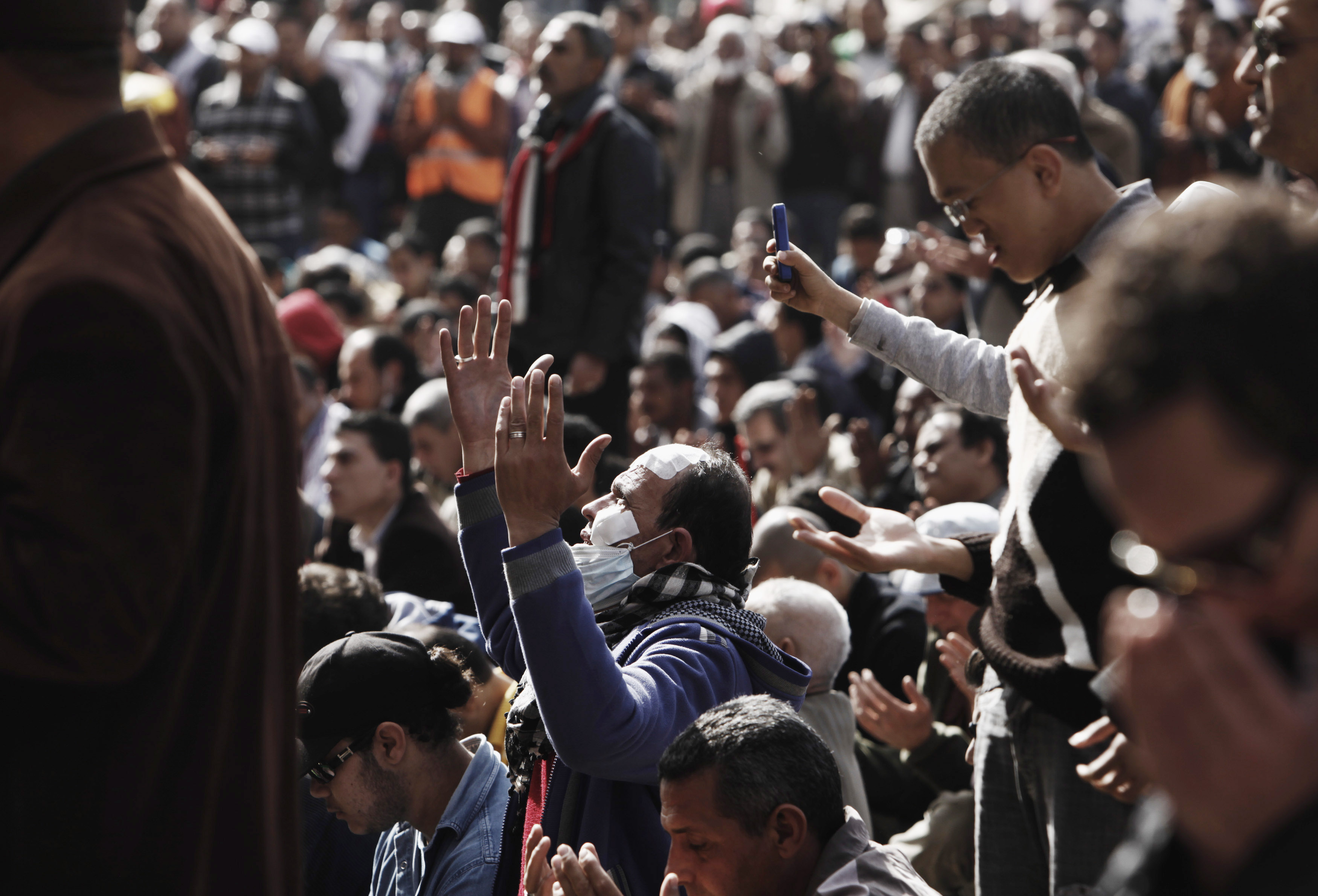
Egyptian men take part in midday prayer during a demonstration in Tahrir Square on January 25, in Cairo, Egypt, the second anniversary of the overthrow of former President Hosni Mubarak’s regime.Ed Giles / Getty
The beginning of this new year in the Arab region looks remarkably like that of past year. 2018 started with social turmoil and protests in Morocco, Tunisia, Jordan, and Sudan — even Iran seemed to catch up with the Arab upheaval. One year later, in this beginning of 2019, the social earthquake is still shaking an Arab region characterized by its high density of volcanoes, whether active exploding ones or dormant ones ready to erupt at any time.
Tunisia, the epicenter of the big earthquake that started on December 17, 2010 in the town of Sidi Bouzid in the country’s impoverished center — the country that inaugurated the Arab Spring, the most exhilarating chapter of Arab modern history (until the next “spring”) — is still going through one explosion after another. The most recent local uprising erupted in the town of Kasserine, in the country’s same impoverished central region, and extended to other areas in the vicinity of the two major cities of Tunis and Sfax.
In Sudan, whose people joined the 2011 Arab Spring early on and were met by harsh repression from Omar al-Bashir’s despotic regime, the popular movement has gone back on the offensive again and again, relentlessly. Like a tempestuous sea whose gigantic waves are knocking at the walls of a huge prison, the people’s movement is gathering momentum, strike after strike, until the day when the Sudanese Bastille will crumble — a day that will come inexorably despite all the efforts deployed by the Sudanese despot’s “brothers” among the Gulf monarchs to rescue him.