Straying From the Party Line
My last years in the USSR.
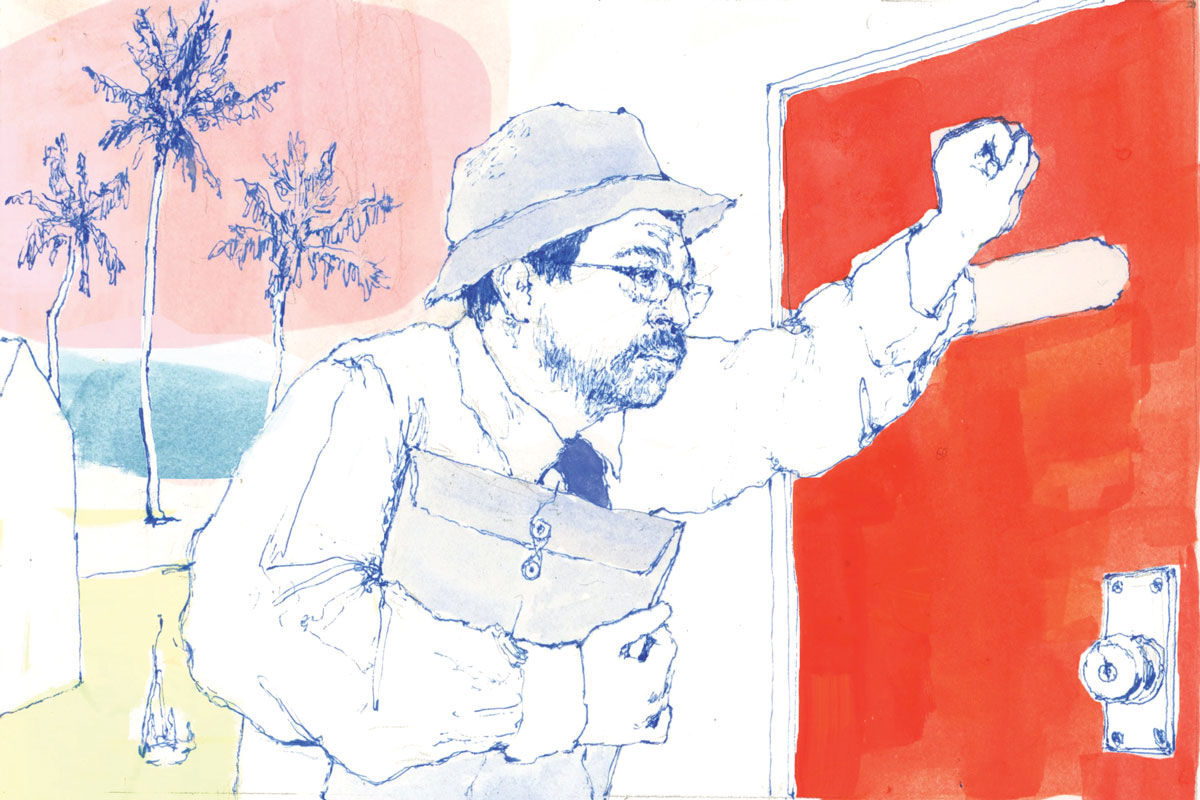
Illustrations by Jia Sung
I knew that i was in trouble again when one cold Moscow night in early spring of 1989, my dissertation adviser at the USSR Academy of Sciences, the prominent and splendidly named Africanist scholar Apollo Borisovich Davidson, called on the phone and asked me tenderly: Dear Georgi Matveevich (the manners of old Saint Petersburg intelligentsia prescribed politely addressing even students by their first name and patronymic and, of course, never as “comrade”), we all know that you do not value your life and your career. But I beg you explain, why you do not value MY life and career?
Admittedly, in academic circles my sanity was regarded as somewhat suspect ever since my recent return after two years as an interpreter of Portuguese and Swahili in Mozambique. Such a reputation was not helped by my shaggy beard, unseasonal tropical tan, camouflage pants with so many handy pockets, and not in the least, the rumor that while doing my dissertation fieldwork I had nearly earned the Combat Red Star (Posthumous) in an encounter with the apartheid-supported “Contras.” But since I had survived, there could be no decoration, only a rumor. At most, curious colleagues would politely ask: Did you kill many? The Soviet participation in Cold War “regional conflicts” was always officially denied. What was undeniable was a hefty dissertation detailing the “social aspects of guerrilla wars in Southern Africa.” The most respected scholars studied something like Renaissance Italy, and they proudly bore their personal eccentricities. But someone had to study contemporary Africa, and were we not entitled to certain eccentricities, too? It was, however, the dissertation on contemporary Mozambique that unexpectedly got me in trouble with no less than the supreme organ, the TseKa. The Russian acronym stood for the apparat of the Central Committee of the Communist Party of Soviet Union. They obtained my drafts from a vigilant, or simply diligent, journal editor and, in the worried words of Professor A. B. Davidson, became “rather irate.”
But who exactly were “they”? And what earned me their thunderous charge of “grossly if not maliciously exaggerating the challenges of socialist orientation in the conditions of newly independent states in Africa”?