The Revolution Party
The question of the party is back on the Left's agenda — and not a moment too soon.
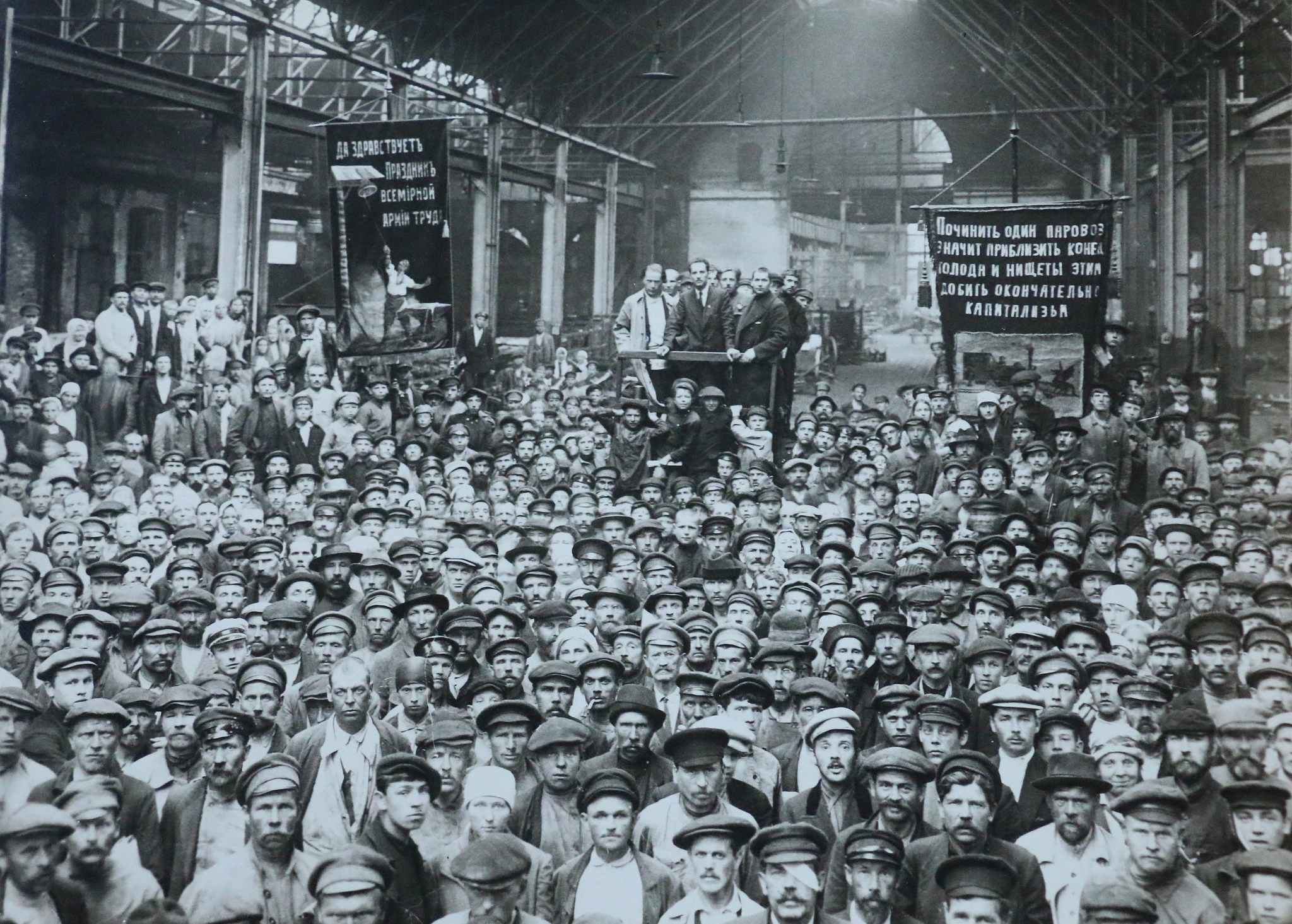
Putilov Plant, Petrograd, meeting of workers, July 1920.Boris Souvarine Papers – Soviet Russia Photos / The Kathryn and Shelby Cullom Davis Library
A fresh and compelling new account of the Russian Revolution to mark its centenary concludes by paying tribute to the Bolsheviks for acting as history’s switchmen, a term derived from the small booths that dotted the railway tracks across the Russian empire, where local revolutionaries had long gathered for clandestine meetings. Against those so-called “legal Marxists” who in 1917 used the term as an epithet to scorn those who would try to divert the locomotive of history on its route from the feudal to the capitalist political station at which it was scheduled to arrive before it could depart for its final socialist destination, In October, China Miéville asks: “What could be more inimical to any trace of teleology than those who take account of the sidings of history?” What makes October 1917 not only “ultimately tragic” but still “ultimately inspiring” is that it showed it was possible to act decisively so as to engage, as Miéville puts it, “the switches onto hidden tracks through wilder history.”
There were, of course, no hidden tracks. If the metaphor were to continue to be deployed, it would require recognizing that the tracks which would form a branch line away from the siding of the October 1917 insurrection had yet to be forged and laid. The Bolsheviks who led the insurrection, above all Lenin and Trotsky, certainly weren’t intending to construct a parallel branch line. Rather they believed that those trains already far ahead of Russia’s on history’s track were scheduled to imminently reach capitalism’s final station (the “highest,” as Lenin had designated it in his 1916 pamphlet on imperialism). And they expected that those trains would hasten to leave that station once inspired by the determination of the Russian switchmen, who would then reengage the switches to merge onto history’s track to the socialist station. But, as was quickly signaled by the failure of the German communist revolution of 1919, the trains on the main track failed to leave the capitalist station. The result, as Miéville puts it, was that the “months and years to follow will see the revolution embattled, assailed, isolated, ossified, broken. We know where this is going: purges, gulags, starvation, mass murder.”
The branch line that was actually constructed — tortuously winding from the Civil War through the marketized NEP of Lenin’s last years to Stalin’s centrally planned industrialization and forced agricultural collectivization — made two-track time a reality for most of the twentieth century. The revolutionaries who broke most sharply with the practice of “socialism in one country,” and suffered grievously from its particular methods, still believed that, as Trotsky put it in exile in 1932, “capitalism has outlived itself as a world system.” And even amidst the American-led capitalist dynamism of the post-1945 era, it was the Soviet track to industrialization that most impressed revolutionaries — and a good many reformists — in developing countries. Yet it turned out that it was the parallel branch line that was constructed from the siding of the October Revolution which culminated in a historical dead-end. Before the century was out, eyeing the high-speed trains now running on the capitalist track, new switchmen appeared all too eager to engage the switches once more and merge with the track on which capitalism sped into the twenty-first century to who knows where.