The Red Scare Scarred the Left — But Couldn’t Kill It
The postwar Second Red Scare successfully smashed the American left. But in the midst of its devastation, a small number of old leftists refused to be shut up by the climate of fear. Without their heroism, the New Left could never have emerged.
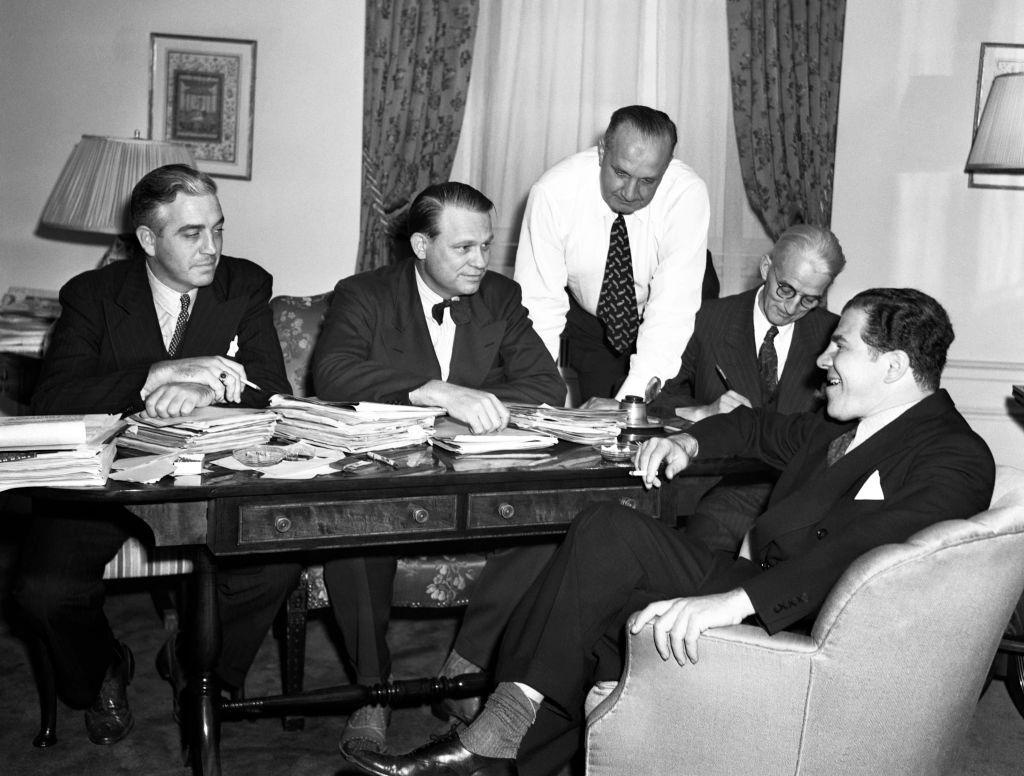
Congressman Martin Dies Jr of the House Committee on Un-American Activities investigates American actor in films, radio, theater, and television Lionel Stander circa 1947 in New York, New York. (Irving Haberman / IH Images / Getty Images)
In one scene in E.L. Doctorow’s Book of Daniel, a fictionalized Abbie Hoffman lectures a fictionalized son of Julius and Ethel Rosenberg that his parents were “pathetic” for “playing the game” by the “rules” and making legal motions as “defendants,” as if under a fair legal trial. This view is rather common among analysts of McCarthyism: that because of the Communist Party of the United States of America’s (CPUSA) bureaucratic and top-down nature, because of the general cultures of conformity in the 1950s, the widespread purge of the Old Left from public life was met with little resistance, and that the doctrinaire and wooden Communists lined up quietly to march off to their demise.
Ed and Jean Fagan Yellin’s memoir, In Contempt: Defending Free Speech, Defeating HUAC, gives the lie to this persistent myth, showing not only the spirited and principled resistance of many left-wing House Un-American Activities Committee (HUAC) defendants but also how their resistance helped open spaces for the emergence of a New Left that could only come into being after HUAC’s power was publicly defeated.
As Ellen Schrecker describes in her classic Many Are the Crimes: McCarthyism in America, McCarthyism “was the most widespread and longest wave of political repression in US history.” The roots of political repression, as Schrecker and others have noted, are broad and deep in US culture, and one can draw many genealogies for the counterrevolution that lasted from the late 1940s until the early 1960s.