Ike & Hayek
Eisenhower’s warning about the “military-industrial complex” marked an era when the American right feared militarism could bankrupt the country and plunge it into socialism.
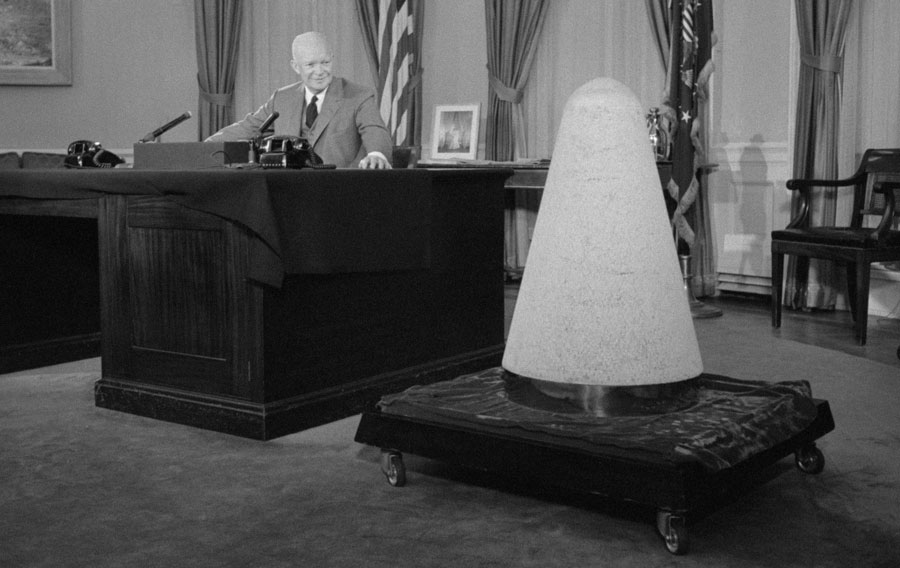
President Dwight Eisenhower giving a 1957 televised speech in the WhiteHouse about science and national security, next to a nose cone of an experimental missile which had been into space and back. (Warren K. Leffler/Library of Congress)
In the 1950s, a new manufacturing industry emerged in the United States, with a freshly coined name — “aerospace” — and a full complement of trade publications, such as Missiles and Rockets and Aviation Week. Like magazines at the doctor’s office, these journals were left lying around the White House, where one day they caught the eye of Malcolm Moos, a political scientist and Eisenhower speechwriter. Moos was troubled by the marketing of mass destruction, and the president, too, was “angered by the excesses, both in text and advertising, of the aerospace-electronics press.”
A seed was planted that would eventually become Eisenhower’s 1961 farewell address, in which the former supreme commander of Allied Forces in Europe expressed his grave concerns about something new in American life, “a permanent armaments industry of vast proportions.”
Eisenhower’s military-industrial-complex speech is remembered well today, for obvious reasons. It was hardly news when Trump announced he would nominate Boeing executive Patrick Shanahan as secretary of defense, only to replace him at the last minute with Mark Esper, a top Raytheon lobbyist. And the military-industrial complex is perhaps the most thoroughly bipartisan of all our institutions: just ask Jeh Johnson, erstwhile Obama homeland security secretary, now on the board of Lockheed Martin and winner of the 2018 Ronald Reagan Peace Through Strength Award. As familiar as Eisenhower’s phrasing is, it is difficult to imagine living in a country where a politician could speak the way he did.