What Is Europe?
Europe Since 1989 is a book about neoliberalism in Europe written by someone who doesn’t know what neoliberalism is, and hasn’t really paid much attention to Europe.
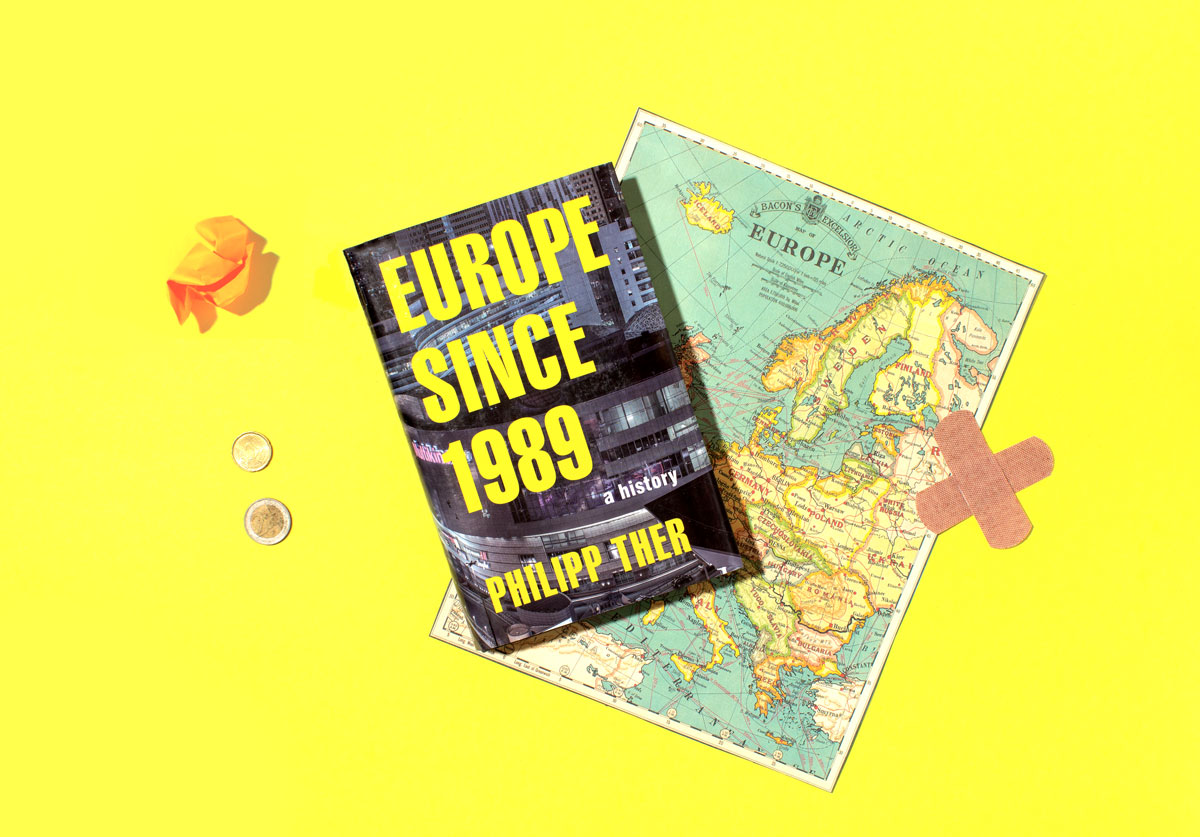
Want to think about Europe like Philipp Ther? Close your left eye and look at the euro. At a certain distance the band-aid disappears. The same happens with the coins if you close your right eye and look at the band-aid. That’s your blind spot.
What went wrong? The promise of a Europe of perpetual peace and prosperity has suffered a hit in recent years. From sovereign debt and eurozone turmoil to Brexit, the European project has been engulfed in crisis.
For historian Philipp Ther, a partisan of Europe, unquestionably the biggest threat is renewed nationalism. And is it a coincidence, he wonders, that the nationalist backlash has been most intense in those countries in the neoliberal vanguard? Not just the United Kingdom but, depressingly, the countries of the 1989 uprisings — Hungary, Poland, Romania, even the Czech Republic. What happened to the generation of 1989? Why is there no living, embodied memory of these liberal revolts comparable to 1848 or 1968?
Europe Since 1989 retraces the steps back to the origins of revolution, the overthrow of the old regime, and the imposition of neoliberalism by means of shock therapy. Ther is not a radical opponent of neoliberalism. A former John F. Kennedy fellow at Harvard, he writes very much as a social-democratic Atlanticist. But, while keen not to “polemically write off the entire project” which “created many opportunities, especially in urban centres,” he is clearly uneasy with the resultant social inequality.